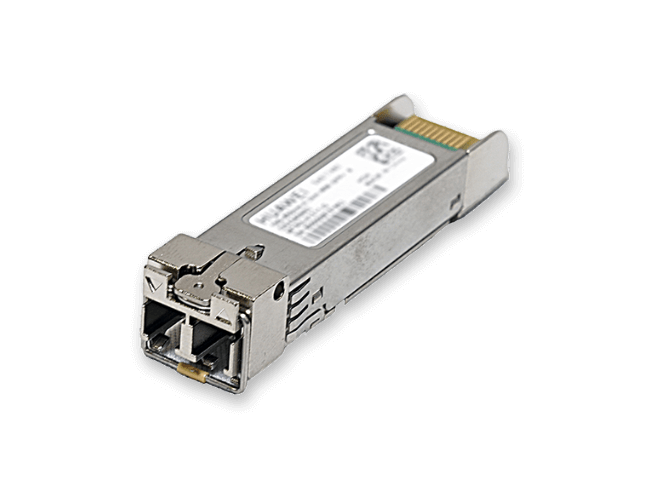
Upgrading a fabric is expensive; upgrading it twice is worse. This guide compares 800G and 400G optical transceivers across the six dimensions that actually drive data-center TCO — speed, form factor, power consumption (LPO vs DSP), reach, switch-port ecosystems and cost trends — and ends with a plain-language decision tree. All module examples are currently available from BS Comtec, including the Huawei OSFP-800G-DR8, Cisco QDD-8X100G-FR and Huawei QSFP-DD-400G-FR4.
Quick Comparison Table
| Dimension | 400G | 800G |
|---|---|---|
| Data rate | 400 Gbit/s (8×50G-PAM4 electrical) | 800 Gbit/s (8×100G-PAM4 electrical) |
| Dominant form factors | QSFP-DD, QSFP112, OSFP | OSFP, QSFP-DD800 |
| Typical power (DSP-based) | ~8–12 W class | 14–18 W typical; LPO variants 6–9 W; LRO 9–12 W |
| Common reach classes | FR4 2 km (duplex SMF), DR4 500 m (MPO), SR8 70–100 m (MMF) | DR8 500 m (MPO-16), FR-class 2 km (parallel SMF) |
| Switch-port ecosystem | Mature: broad QSFP-DD/QSFP112 switch line-up from all major vendors | Scaling fast: 800G OSFP/QSFP-DD800 ports concentrated in AI spine-leaf and cloud-core switches |
| Cost trend | Falling steadily as volume shifts to 800G | 2026 volume ramp: Goldman Sachs raised its 800G unit forecast from 25M to 33.5M (+58%) |
Power figures are industry-reported ranges for 800G-class modules (DSP 14–18 W, LPO 6–9 W, LRO 9–12 W); the Accelink 800G DR8 LPO demoed at OFC 2025 ran at ≤7.5 W.
The Modules Behind the Table (All In Stock at BS Comtec)
Huawei QSFP-DD-400G-FR4 — the 400G duplex workhorse
The Huawei QSFP-DD-400G-FR4 carries 400 Gbit/s as four CWDM wavelengths (1271–1331 nm) over an ordinary duplex LC singlemode pair to 2 km, on 8×50G-PAM4 electrical lanes. It is the lowest-friction 400G choice for teams that want to light up 400G over existing duplex fiber plant — no MPO re-cabling required.
Huawei OSFP-800G-DR8 — built for AI leaf-spine fabrics
The Huawei OSFP-800G-DR8 delivers 800 Gbit/s as eight 100G-PAM4 lanes at 1311 nm over a single MPO-16 APC connector, documented to 500 m on singlemode fiber. It targets exactly the environment 800G was designed for: dense AI/GPU training fabrics where hundreds of leaf-spine hops run between neighboring racks, and where each 800G port can also break out to 8×100G DR/FR-class endpoints.
Cisco QDD-8X100G-FR — 800G over 2 km, QSFP-DD footprint
The Cisco QDD-8X100G-FR implements 8×100GBASE-FR (IEEE 802.3cu) over dual MPO-12 APC parallel singlemode ribbon connectors with a 2 km reach, at a 17 W maximum power draw. It is the pragmatic 800G option when you need more than 500 m — building-to-building 800G aggregation on a campus, for example — while staying in the QSFP-DD ecosystem rather than OSFP.
Power: Where LPO Changes the Math
At 800G, module power is no longer a footnote. A DSP-based 800G module typically draws 14–18 W; across a 400-port spine, that is multiple kilowatts of optics alone before switch silicon. LPO (linear-drive pluggable optics) removes the DSP and cuts consumption to roughly 6–9 W, with LRO (linear receive optics) in between at 9–12 W. The trade-off: LPO requires host-platform support for linear interfaces and currently concentrates on ≤500 m in-hall links. The LPO MSA published its 100G-DR-LPO v1.01 specification in March 2025, and Accelink’s OFC 2025 demonstration of an 800G DR8 LPO module at ≤7.5 W shows the ecosystem is production-bound. For 2026 planning: DSP remains the compatibility default; LPO is the power play for AI fabrics that control both ends of the link.
Decision Tree: Which One Should You Buy?
Work through these questions in order:
- Is your highest aggregation tier still 100G/25G server access? If your leaf layer is 100G and your workload is enterprise, telecom edge or hosting — stay on 400G. The QSFP-DD-400G-FR4 class delivers 4× the leaf bandwidth over duplex fiber you already own. 800G would idle most of its capacity.
- Are you building or expanding an AI/ML training cluster? GPU fleets multiply optical demand — Huawei’s official figure is 2.5–4 additional modules per GPU card. At this density, 800G DR8 leaf-spine fabrics (Huawei OSFP-800G-DR8) over MPO-16 trunks are the reference architecture; 400G creates port-count and fiber-count pressure that 800G halves.
- Is your 800G reach requirement beyond 500 m? For in-hall AI fabrics, DR8 at 500 m is the cost-optimal parallel design. For spans up to 2 km — across campus buildings or between data halls — the Cisco QDD-8X100G-FR covers the gap at 17 W per module without leaving the QSFP-DD world.
- Is power the binding constraint? If cooling headroom, not budget, is your ceiling (a common situation in Middle East and South American colocation retrofits), specify LPO variants for ≤500 m links where your switch platform supports linear optics — and DSP everywhere else.
- Do you need to protect existing duplex SMF investment? Then 400G FR4 today and 800G FR-class tomorrow is the smoothest migration path; both run on the same duplex singlemode plant.
Bottom line: 400G is the rational default for enterprise and telecom fabrics through 2026; 800G is mandatory equipment for AI training clusters and hyperscale leaf-spine builds; the two will coexist in the same data center for years — 800G at the spine, 400G feeding the leaf.
Cost Trend: Buy on Curves, Not on Lists
Goldman Sachs raised its 2026 forecast for 800G module shipments from 25 million to 33.5 million units (+58%), and industry trackers expect full-year volumes potentially exceeding 40 million as AI spending compounds. Volume is doing to 800G pricing what AI did to 400G pricing a cycle earlier: compressing it. Practical buying guidance follows from that curve: lock 400G prices now for access-layer refreshes (the discount window is wide), and negotiate 800G in volume batches — per-unit pricing moves quarter to quarter.
Order With Confidence — Talk to BS Comtec
Send BS Comtec your switch models, port types and fabric design (leaf counts, spine counts, reach between tiers), and we will return a matched 400G/800G bill of materials with a quotation — Huawei, Cisco, NVIDIA and Accelink, from 1G SFP to 800G OSFP — typically within one business day, with stock confirmation for project timelines in Europe, South America, the Middle East, Africa and Russia.
- WhatsApp: +86 135 8237 6986
- Inquiry form: use the inquiry form on our website
Q: What is an OSFP 800G module used for?
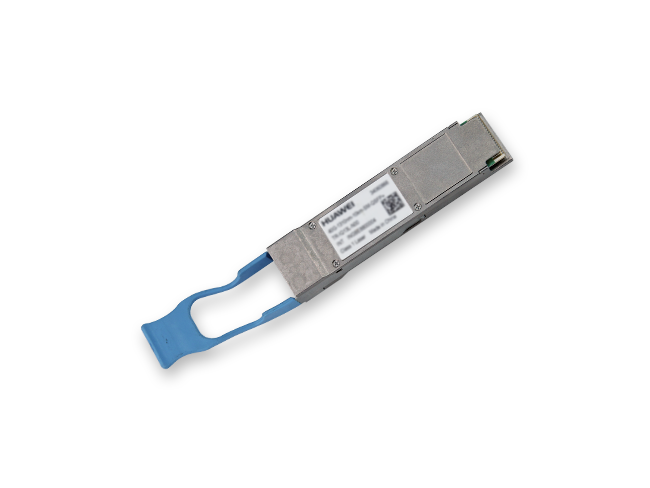
A: OSFP (Octal Small Form-factor Pluggable) carries eight electrical lanes of 100G for 800 Gbps total, and it is the workhorse pluggable on current 51.2T-class data-center switches. Typical uses: 800GBASE-SR8/DR8/FR4 links between AI/HPC leaf and spine layers, 800G uplinks from 400G aggregation tiers, and — with dual-port variants — breakout into two independent 400G connections for cost-efficient top-of-rack wiring.
Do not confuse OSFP with QSFP-DD: both deliver 800G, but the connectors and cage dimensions differ and the two families are not interchangeable, so the module must match your switch port type before you order. OSFP also reserves a higher power budget (15 W class and above) for long-reach and coherent variants. We stock OSFP and QSFP-DD 800G transceivers from Huawei, Cisco and compatible lines — send us your switch model and we will match the right form factor.