In most telecom DC power projects, the hardest question is not “which rectifier module is best” but “which module can replace the one already installed in my shelf.” Operators across Europe, South America, the Middle East, Africa and Russia constantly face this situation: a legacy plant reaches end of sale, the site cannot be taken offline for a full power system upgrade, and the engineering team needs a practical rectifier module cross-reference between Huawei, Vertiv, Eltek and Delta product families.
This guide walks through the four major ecosystems, explains what makes a cross-reference valid (and what makes it a risky guess), and gives you a step-by-step method to qualify a replacement module before you commit a tender or a spare-parts order. If you need actual units to test in the field, you can browse our rectifier module catalog and request a quote for the candidates that fit your shelves.
Why Rectifier Module Cross-Reference Matters
Telecom DC power plants are long-life assets. A rectifier shelf installed ten or fifteen years ago may still carry another decade of service, while the original module family has been discontinued or restricted in certain regions. When the installed base is large — hundreds or thousands of sites — replacing complete power systems is rarely economical. Cross-referencing modules is therefore a core skill for network operations teams, installers and distributors alike.
A good cross-reference delivers three outcomes:
- Continuity: the site keeps running with the same bus voltage, battery policy and load profile.
- Compatibility: the replacement module physically fits the shelf, shares the same connector logic and communicates with the existing controller.
- Economics: the operator buys only the modules it needs, not an entire new plant, cabling rework and site visits.
Getting any of these wrong turns a simple module swap into an unplanned outage. That is why a structured cross-reference process — not a datasheet glance — is essential.
The Four Major Rectifier Ecosystems at a Glance
Huawei, Vertiv, Eltek (now part of Vertiv) and Delta each built large installed bases in different markets and generations of networks. Their module families differ in bus architecture, shelf design, controller philosophy and spare-parts availability. The table below summarizes the practical differences that matter most in a cross-reference decision.
| Dimension | Huawei | Vertiv / Eltek | Delta |
|---|---|---|---|
| Typical module role | Embedded plants and integrated cabinets in mobile networks | Shelf-based plants in central offices and data rooms | Shelf and embedded systems, strong in industrial and carrier sites |
| Shelf philosophy | System-integrated (module, controller and distribution designed together) | Modular shelves with hot-swap modules and separate controller | Modular shelves, hot-swap, controller on shelf front |
| Controller logic | Plant-level controller tightly coupled to module firmware | Controller-agnostic shelf, modules report via digital bus | Controller supervises modules over proprietary CAN bus |
| Cross-reference difficulty | High — third-party modules rarely integrate with the plant controller | Moderate — compatible replacements exist for legacy Eltek shelves | Moderate — depends on shelf generation |
| Best cross-reference case | Like-for-like Huawei replacement | Legacy Eltek module replaced by a compatible third-party unit | Legacy Delta module replaced within the same shelf family |
Huawei Modules
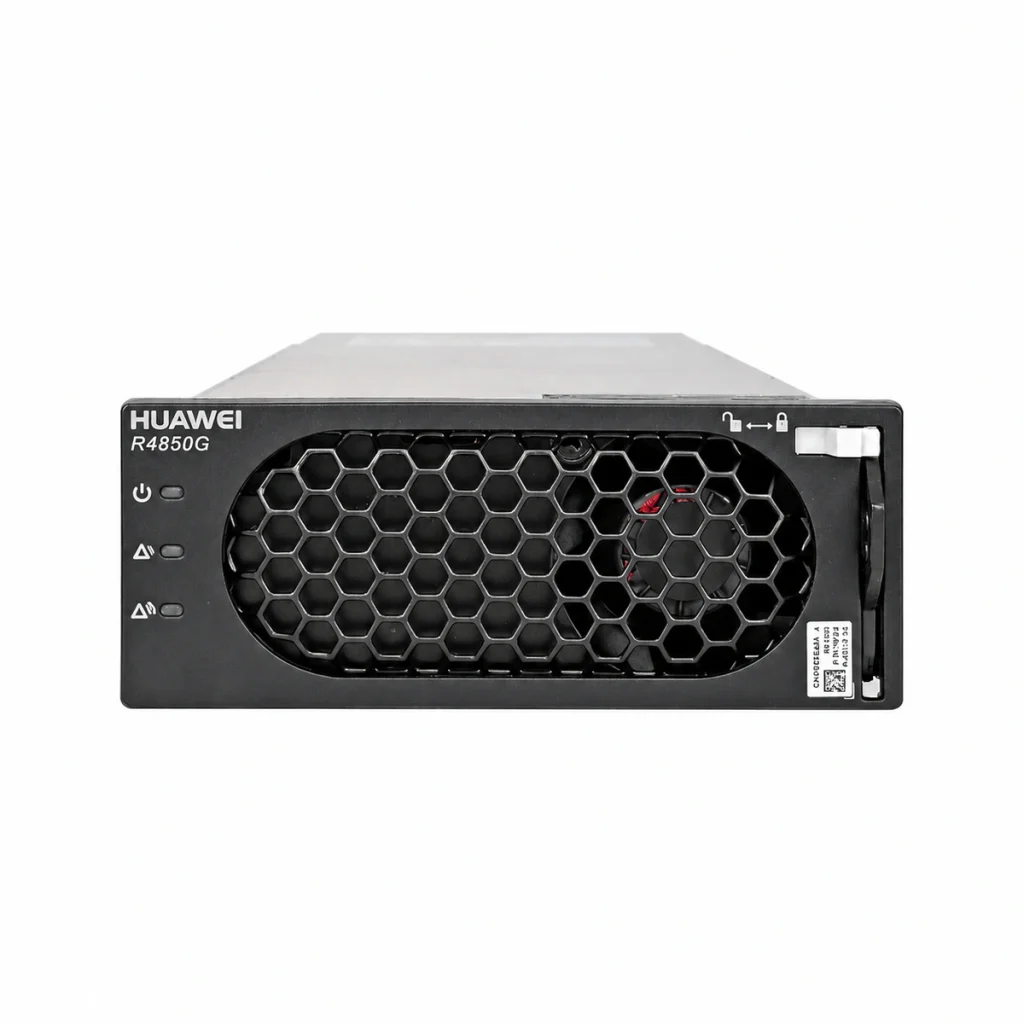
Huawei rectifier modules are designed as part of a complete embedded power system. The module firmware, the plant controller and the distribution unit are validated together, which makes the system very reliable when everything is Huawei — but also means a third-party module usually cannot join the plant controller’s digital bus. For Huawei plants, the safest cross-reference is a like-for-like Huawei module of the same family and output rating. When that family is unavailable in your region, the practical fallback is to keep a small bank of original spares while planning a staged system replacement.
Vertiv and Eltek Modules
The Eltek Flatpack heritage lives inside the Vertiv portfolio, and the Flatpack shelf concept — a front-access hot-swap module with a separate controller — became a de facto standard in many European, Middle Eastern and African networks. Because the shelf is modular, a compatible replacement module that matches the shelf’s mechanical outline, connector pinout and digital signaling can often be installed without rewiring. This is the classic success case of rectifier module cross-reference: the legacy Eltek or Vertiv shelf stays, and a functionally equivalent module takes its place. Our Vertiv-compatible 3500W rectifier module is one example frequently used in such projects; contact us to request a quote and confirm fitment for your shelf generation.
Delta Modules
Delta power systems are common in carrier central offices, industrial sites and edge facilities. Like Vertiv, Delta uses shelf-based architecture with a supervising controller on the shelf front. Cross-referencing a Delta module requires matching the shelf generation: older and newer shelves use different mechanical and communication interfaces, so a module that works in one shelf family will not automatically work in another. Always verify the shelf model and controller version before ordering.
What a Valid Cross-Reference Actually Requires
Two modules with the same output voltage and wattage are not automatically interchangeable. A valid cross-reference is confirmed only when all of the following layers line up:
1. Electrical Compatibility
- Output voltage range: the replacement must support the same float and equalize voltages required by your battery chemistry — VRLA and lithium batteries set different charging windows.
- Output current and power rating: equal or higher is acceptable; lower ratings change your N+1 redundancy math.
- Input voltage range: sites in regions with weak grids or unstable generators need a wide AC input window; a replacement with a narrower range will trip or derate.
- Power limit and load sharing: mixed fleets must share current gracefully; modules that cannot share load will fight each other or run one at full capacity while others idle.
2. Mechanical Compatibility
- Shelf slot dimensions and module depth must match so the module seats fully and front panels align.
- The AC and DC connectors (or blade connectors) must match the shelf backplane — adapters are a last resort and add failure points.
- Airflow direction (front-to-back vs back-to-front) must match the shelf cooling design, or you create hot spots.
3. Communication Compatibility
- The module must speak the shelf’s digital bus language so the controller can read alarms, set output voltage and manage load sharing.
- Where the controller cannot be integrated, some operators run replacement modules in a standalone or locally configured mode — acceptable for simple sites, risky for plants with battery management policies enforced by the controller.
4. Policy Compatibility
- Battery temperature compensation, low-voltage disconnect behavior and alarm thresholds must behave the same way, otherwise your monitoring platform will report false conditions after the swap.
Step-by-Step: Qualifying a Replacement Module
Use this sequence before approving any cross-reference at fleet scale.
- Document the installed base. Record shelf model, controller model, module family, firmware versions and battery chemistry for each site group.
- Shortlist candidates. From the electrical and mechanical criteria above, list modules that could match each shelf generation.
- Bench-test one unit. Install a candidate module in a lab shelf (or a low-risk site). Verify it seats correctly, powers up and communicates with the controller.
- Run a parallel test. Operate the candidate alongside original modules for at least one charge cycle. Watch current sharing, alarm behavior and fan response.
- Validate battery policy. Confirm float/equalize voltages and temperature compensation match what the controller commands.
- Pilot at 2–3 live sites. Different site types (indoor, outdoor cabinet, generator-fed) expose different edge cases.
- Standardize and document. Write the approved cross-reference into your spare-parts matrix so field teams stop improvising.
Common Cross-Reference Mistakes to Avoid
- Matching wattage only. A module can have the right power rating but the wrong connector, airflow or communication protocol.
- Ignoring controller integration. A module that works electrically but stays invisible to the controller leaves the site without proper alarms and battery management.
- Mixing airflow directions. Silent on the bench, destructive in summer: reversed airflow derates the module and heats neighboring units.
- Buying before bench-testing. Container-quantity orders based on datasheet similarity are the most expensive mistake in this domain.
When to Cross-Reference and When to Replace the Plant
Cross-referencing is the right move when the shelf, cabling and distribution are healthy and the pain point is module availability. A full system replacement makes more sense when the controller is obsolete, the distribution needs redesign for higher loads, or the site is being upgraded for 5G capacity anyway. A quick heuristic: if more than half of the modules in a shelf must be replaced, price the complete system against the module bundle — the gap narrows faster than most teams expect. For full plants, review our DC power supply systems range and request a quote with your site parameters.
How We Support Cross-Reference Projects
We supply compatible rectifier modules for the major legacy shelf families and ship to projects in Europe, South America, the Middle East, Africa and Russia. Our engineering team reviews your shelf model and controller version, confirms fitment before you order, and can support a pilot-site validation program. Whether you need a handful of spares or a fleet-wide replacement plan, send us your installed-base list and request a quote for a matching proposal.
Frequently Asked Questions
Can I mix Huawei, Vertiv, Eltek and Delta rectifier modules in the same shelf?
No. Each shelf is designed around its own mechanical outline, backplane connectors and digital communication bus. Modules from different vendors will not physically fit or communicate. Cross-reference means finding a compatible module for one vendor’s shelf, not mixing vendors in one shelf.
Will a third-party replacement module void my system warranty?
It depends on the system vendor’s warranty terms and who maintains the plant. Many operators with out-of-warranty legacy systems accept compatible modules as the most economical path. Review your maintenance contract and, where in doubt, run the replacement in a pilot site first. We can provide documentation to support your internal approval process.
How do I identify which rectifier module family is installed at a site?
Read the label on the module front panel (family and rating) and the shelf/controller label inside the plant. Photographing the module front, the shelf backplane and the controller display gives our team enough information to confirm a compatible replacement. The controller model matters as much as the module model, because it defines the communication requirements.
Do replacement rectifier modules support lithium battery charging?
Many modern modules support the wider voltage window required by lithium batteries, but you must verify that both the module and the site controller support the lithium charge profile and temperature compensation. For VRLA sites being converted to lithium, confirm the controller’s battery type setting and the module’s voltage range together — not separately.