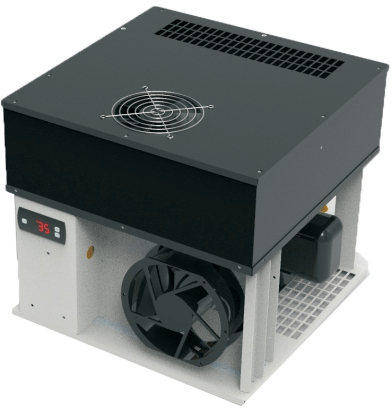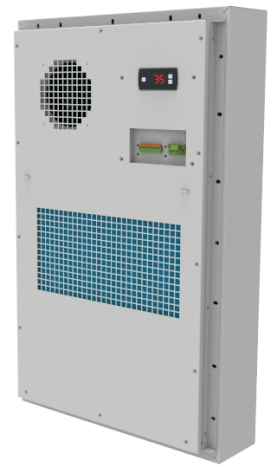
If you are sourcing enclosure or room cooling in Europe or Latin America and your search history looks like “blue e+ rittal” or “blue e+ rittal prix”, you already know the product: Rittal’s Blue e+ series is the inverter-driven successor to the widely deployed Blue e line, and it dominates buyer shortlists for electrical enclosure cooling. But procurement teams rarely buy it on first contact. Long factory lead times, minimum-order friction, configuration complexity and price variance between distributors push a large share of buyers to evaluate alternatives before they sign the purchase order. This guide is written for exactly that moment. It explains what the Blue e+ actually does, maps its capacity classes to equivalent precision cooling options, and walks through a five-step cross-reference method you can apply to any quotation sitting on your desk. Where our own portfolio covers a capacity class, we link the product page; where it does not, we say so plainly. All capacity figures below come from manufacturer-published specifications, and certifications belong to the respective brand owners — we are a distribution and integration partner, not the certification body.
What the Rittal Blue e+ actually is — and why buyers cross-shop it
The Blue e+ series is Rittal’s current-generation cooling platform for electrical enclosures and small technical rooms, with the wall-mounted range covering roughly 1.6 to 5.5 kW of cooling capacity and larger S-series and chiller variants extending the family for room-level and liquid-based applications. Its headline engineering change over the previous Blue e generation is the switch to a speed-controlled (inverter) compressor paired with electronically commutated (EC) fans. Rittal markets this combination as delivering up to 75% energy savings compared with the outgoing generation — a manufacturer claim, and one reason used and new Blue e+ units hold their resale value unusually well in the secondary market.
So why do buyers look elsewhere? Four reasons come up in almost every cross-reference inquiry we handle. First, lead time: standard configurations of the wall-mounted Blue e+ are widely stocked in Germany and Central Europe, but non-standard voltages, controller options and accessory packages frequently fall into factory-order territory with multi-week queues — a real problem when a failed enclosure cooler is holding a production line or a telecom site down. Second, price transparency: “blue e+ rittal prix” searches exist precisely because the same model number can quote very differently between an authorized distributor, a panel builder’s reseller margin, and a grey-market listing. Third, availability in Latin America and other export markets, where local distributor depth is thinner and import duty on a finished German unit compounds the landed cost. Fourth — and most common in our inbox — the project quietly outgrows enclosure cooling altogether: the customer started by wanting to replace a 4 kW enclosure unit and ends up needing room-level precision cooling, where a different class of equipment is the better answer.
None of these points argue against the Blue e+ on engineering merit. If you have a stocked local distributor and the standard configuration fits, buying it is a sound decision. This guide exists for the situations where that is not the case.
Blue e+ capacity cross-reference: what to compare at each size
A cross-reference is only as good as the parameters you match on. Cooling capacity in kilowatts is the obvious one, but it is not sufficient on its own. Before comparing any two units, put the following five parameters side by side, because they are where replacement projects actually fail: the electrical supply (phase and voltage, since Blue e+ variants exist in multiple supply configurations and a 230 V single-phase site cannot absorb a 400 V three-phase-only unit without an electrician’s involvement); the installation interface (the enclosure cut-out dimensions and mounting bracket pattern for wall-mounted units, which are brand-specific and never truly “drop-in”); the airflow arrangement and free-blow direction relative to your internal cabinet layout; the control integration (Blue e+ units communicate through Rittal’s own controllers and, on option, gateways into higher-level systems — a different brand will bring its own controller and its own protocol list); and the refrigerant and ambient rating, which you should re-confirm from the nameplate of the unit being replaced rather than from memory.
With those parameters fixed, the table below maps the Blue e+ capacity classes to the decision we recommend most often in practice.
| Blue e+ class (wall-mounted) | Typical application | Recommended cross-reference move |
|---|---|---|
| 1.6 – 2.5 kW | Single electrical enclosure, control cabinet, small outdoor cabinet | Stay in enclosure cooling. Match cut-out dimensions and supply first, capacity second. If the cabinet sits inside a conditioned room, a room-level unit may already be covering the load — verify before buying anything. |
| 4.0 kW | Larger control cabinets, small switchgear enclosures, drive cabinets | Stay in enclosure cooling for a like-for-like swap; consider a room-level precision unit (6 kW class and up) only if multiple cabinets share one space and the enclosure units are aging as a fleet. |
| 5.5 kW (top of wall-mounted range) | Dense drive/PLC cabinets, small technical rooms ventilated as a whole | This is the crossover point. If more than two enclosures need cooling in the same room, price a small room-level precision AC against two or three enclosure units — total cost often favors the room unit. |
| Blue e+ S / larger family variants | Room-level and process cooling, IT and telecom rooms | Move to room-level precision air conditioning outright. See the capacity-matched alternatives in the next section. |
One warning that saves buyers real money: do not assume the kilowatt figure on a Blue e+ nameplate is the load it was actually carrying. Manufacturers rate cooling capacity at defined internal and ambient conditions, and a unit that “was 4 kW” in a 35°C machine hall may have been delivering noticeably less. Size the replacement from the measured heat load of the cabinet or room, not from the old nameplate — the five-step method at the end of this guide shows how.
The 1.6–5.5 kW wall-mounted segment: an honest note
We will not pretend to a cross-reference we cannot stand behind: our current precision cooling portfolio starts at the 6 kW room-level class, so we do not offer a like-for-like competitor to the 1.6–5.5 kW wall-mounted enclosure segment. For a single cabinet in a single location, our standard advice is to source the enclosure cooler — Blue e+ or an equivalent brand — through whichever channel gives you the best combination of stock, warranty and voltage match, because at that scale the brand difference matters less than installation fit and spare-part availability. Where we add value in this segment is fleet-level thinking: if you are maintaining dozens of enclosure coolers across a plant or a telecom estate and the replacement-and-stock cycle is consuming budget, consolidating the room-level cooling (one properly sized precision unit for the space) frequently eliminates the enclosure-cooling problem entirely. That decision — not the brand of the next wall-mounted unit — is usually where the durable savings sit.
Room-level alternatives: capacity-matched precision cooling
Once the cooling duty moves from a single enclosure to the room that houses it, the comparison set changes completely, and this is the segment where we compete every day. The relevant capacity-matched options in our portfolio, all published specifications, are summarized below alongside the in-row class for completeness.
| Series (in stock line) | Form factor | Capacity range | Best fit when replacing Blue e+ deployments |
|---|---|---|---|
| Stulz CyberAir Mini | Room-level, DX precision AC | up to ~35 kW (9–34.7 kW class) | Small technical rooms and telecom equipment rooms previously served by a cluster of wall-mounted units; German engineering pedigree makes it an easy internal sell where brand continuity matters. |
| Envicool CyberMate V+ | Room-level precision AC | DX 6–120 kW / CW 40–200 kW | The widest single-series coverage in our line-up; the natural replacement when a Blue e+ 5.5 kW enclosure decision expands into a 10–100 kW room-level duty, with attractive landed cost into Latin American and African projects. |
| Vertiv Liebert PEX3 | Room-level, R410A precision AC | 25–100 kW | Mid-size data rooms and switchrooms where the buyer’s standard already references Vertiv/Liebert and the procurement file needs a name the auditor recognizes. |
| Stulz CyberAir 3PRO DX | Room-level, DX precision AC | 22–150 kW | Larger data centers and process rooms at the top of the range; the workhorse choice when redundant (N+1) configurations of multiple units are specified. |
| Vertiv Liebert CRV4 | In-row precision cooling | 18 kW class per unit | Rack-level close-coupled cooling in edge and mid-size data rooms; relevant when the “room” is actually a row of IT racks rather than a walk-in space. |
| Delta RowCool R Series DX | In-row, direct expansion | 30–45 kW | High-density rack rows in carrier and enterprise data centers; pairs with hot-aisle containment where Blue e+ enclosure cooling was never the right tool. |
How to read this table against a Blue e+ baseline: a single wall-mounted Blue e+ serving one cabinet corresponds to nothing above — keep it in enclosure cooling. A room running three or four enclosure coolers totalling 10–15 kW maps naturally to the CyberAir Mini or the lower CyberMate V+ frames. A 30–80 kW switchroom or small data hall maps to PEX3 or mid CyberMate V+ frames, and anything from roughly 80 kW upward belongs to the CyberAir 3PRO class or in-row architectures with containment. If your quote conversation started with “blue e+ rittal prix” and ends above 10 kW of room duty, you are almost certainly comparing the wrong product category on the Rittal side, and the room-level table above is the fair comparison.
Five steps to specify a replacement without surprises
Step one: measure the heat load, do not inherit it. Sum the nameplate power draw of everything inside the cabinet or room, apply your redundancy and growth margin, and convert to a cooling duty in kilowatts. A rule of thumb for enclosure electronics is that nearly all electrical input becomes heat, so a cabinet drawing 2.8 kW continuous needs roughly 3 kW of cooling at your worst-case ambient — before safety margin. The old Blue e+ nameplate is a data point, not the requirement.
Step two: fix the electrical supply and installation envelope. Record the supply available at the installation point (single- or three-phase, voltage, frequency — Latin American sites in particular mix 220 V/60 Hz and 380 V/60 Hz within one country), then measure the physical envelope: cut-out dimensions for enclosure units, floor or wall space and condensate routing for room units. This step eliminates roughly half of candidate models in ten minutes.
Step three: define the control requirement. List what the current Blue e+ installation actually does beyond cooling: alarm contacts to a building management system, communication into a PLC or SCADA via a gateway, fan speed profiles tied to cabinet temperature. Whatever the replacement is, it brings its own controller; confirm up front that its alarm and communication interfaces cover the same list, because retrofitting integration after delivery is the most expensive line item on any commissioning invoice.
Step four: check the commercial frame. Confirm the warranty terms in writing, the genuine availability of consumables and spare parts (fans, compressors, filters) in your region, and the certification documentation the brand owner publishes for your target market — CE documentation for European Union installations, and the equivalent local approvals for Latin American markets. We supply what the manufacturer certifies; we do not rebrand or re-issue certificates, and you should treat any supplier who claims otherwise as a risk.
Step five: price the total position, not the unit. Landed cost for a European-built unit into Latin America versus regional stock from our warehouses, freight class, startup assistance, and the value of lead time you do not have — put all four on one line before comparing quotations. A unit that ships in two weeks from regional stock routinely beats a nominally cheaper unit with an eight-week factory queue and a customs cycle behind it.
Reading “blue e+ rittal prix” listings without getting burned
The reason identical Blue e+ model numbers quote at wildly different prices is configuration and channel, and you can protect yourself by demanding three clarifications on every quote. First, configuration code: a Blue e+ unit’s price moves materially with its controller version, door/panel package and integrated power connections, so a price without the full article number is a price without meaning — ask for the complete order code and match it to the manufacturer’s catalogue. Second, generation: the Blue e line still circulates in the used and surplus market, and “Blue e” priced near “Blue e+” should trigger the question of which generation you are actually being offered, since the inverter technology — and the energy economics behind it — is the entire point of the e+ platform. Third, channel and warranty: distributor stock carries the manufacturer warranty through that channel; grey imports frequently carry none that is enforceable in your country, which is a fine gamble on a 400 euro component and a poor one on a multi-kilowatt cooling unit running a production process. The same three checks apply to any alternative brand you source from us or from anyone else, and we publish complete order information on every product page precisely so this verification takes minutes instead of weeks.
Compatibility checklist before you sign the purchase order
- Heat load calculated from connected load and worst-case ambient, not from the old unit’s nameplate.
- Supply voltage, phase and frequency confirmed at the installation point.
- Cut-out dimensions and mounting pattern matched for enclosure units; floor plan, condensate route and clearances for room units.
- Alarm contacts and communication interfaces (BMS, PLC, SCADA) listed and matched against the replacement controller.
- Refrigerant type and ambient operating range taken from the nameplate and confirmed in writing on the replacement.
- Warranty terms, spare-part availability and certification documents confirmed for your target market.
- Lead time, freight and landed cost compared on a single total line — regional stock versus factory order.
Send us the completed list, ideally with a photo of the existing unit’s nameplate and the cabinet or room dimensions, and we will return a capacity-matched cross-reference quotation with the nearest in-stock equivalent — or tell you honestly that you should stay with the original brand, whichever serves the project better. That nameplate photo plus a one-line description of the site is genuinely enough to start; our engineers do this matching daily across the Stulz, Vertiv, Envicool and Delta lines and will tell you within one working day where your duty lands.
FAQ — Rittal Blue e+ Replacement and Cross-Reference
Q: Is there a direct drop-in replacement for a Rittal Blue e+ wall-mounted unit?
A: No brand offers a hole-for-hole drop-in replacement, because the enclosure cut-out dimensions and mounting patterns are brand-specific. A practical replacement matches the same capacity class and supply voltage, then adapts the cut-out during the swap — usually a same-day job for a panel builder. If the enclosure sits in a room with several other cabinets, the better replacement is often a room-level precision unit rather than another enclosure cooler.
Q: What capacity replaces a Blue e+ 4.0 kW unit?
A: Start from the measured heat load, not the 4.0 kW nameplate. Sum the connected electrical load inside the cabinet, treat nearly all of it as heat, add your safety and growth margin, and size the replacement to that figure at your worst-case ambient temperature. In practice many “4 kW” enclosures were running well below their nameplate duty, and buyers who re-measure end up with a smaller, cheaper replacement — while buyers who copy the nameplate sometimes discover the old unit was undersized all along.
Q: Can I keep my existing controller or sensors with a different cooling brand?
A: No. The Blue e+ controller and its accessories are proprietary to Rittal, and a different brand brings its own controller with its own interface list. What you should preserve is the function, not the hardware: alarm signals into your BMS, communication into a PLC or SCADA system, and temperature-based speed control. List those functions before ordering and confirm the replacement controller covers them natively or through a standard protocol such as Modbus.
Q: Why do “blue e+ rittal prix” search results show such different prices for the same model?
A: Three reasons: configuration, generation and channel. The same Blue e+ frame prices differently with different controller and accessory codes; the previous Blue e generation still circulates in used and surplus channels at tempting prices; and unauthorized grey-market listings undercut distributor stock by stripping out the enforceable manufacturer warranty. Always demand the complete order code and the warranty terms in writing before comparing any two prices.
Q: Are the alternatives certified the same way as Blue e+?
A: Certification belongs to each brand owner, not to distributors, so the correct comparison is certificate to certificate: ask any supplier for the manufacturer’s CE documentation for European installations or the relevant local approvals for Latin American markets, and verify the certificate number against the manufacturer’s own published documents. We supply the certification documentation that each manufacturer issues for the products we distribute; we do not issue or rebrand certificates ourselves, and no honest distributor does.
Q: What information should I send for a cross-reference quotation?
A: Five items get you a same-week answer: a photo of the existing unit’s nameplate, the cabinet or room dimensions, the electrical supply available at the site, your worst-case ambient temperature, and any control integration the new unit must support. Add your target delivery window and destination port or city, and we will return capacity-matched options from the Stulz, Vertiv, Envicool and Delta lines with lead times and landed-cost guidance for your market.