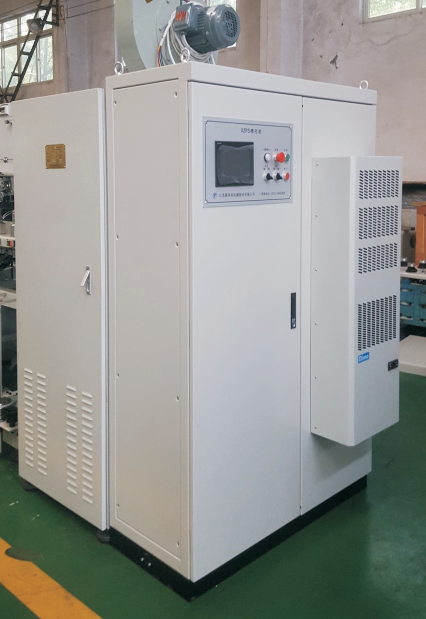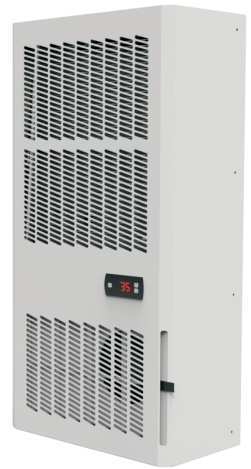
If you are specifying cooling for telecom cabinets, outdoor battery cabinets, industrial control panels or vending and billboard enclosures, the fastest way to narrow your options is to match heat load to capacity and then choose the mounting type and power input that fits the site. This guide walks through the full BSCOMTEC OEM cabinet air conditioner lineup – DC in-cabinet units from 300 W to 5000 W, split systems, top-mounted units, billboard coolers and vending machine air conditioners – and shows where each fits, how to calculate the load, and the five sizing mistakes that cause most field failures.
Every model in this guide is available factory-direct with OEM and ODM programs: your brand on the unit, your logo on the display, your packaging, and firmware options matched to your market. We ship from our own warehouse to projects across Europe, Latin America, the Middle East, Africa and Russia, with minimum orders starting from a single unit on stocked models.
Quick Answer: Which Cabinet Air Conditioner Fits Your Application?
| Application | Recommended type | Capacity range | Power input |
|---|---|---|---|
| Telecom outdoor cabinet, -48V DC site | DC in-cabinet air conditioner | 300 – 5000 W | -48 V DC |
| Battery cabinet with lithium packs | DC in-cabinet, low-vibration | 300 – 2000 W | -48 V DC |
| Indoor server or control room cabinet | AC cabinet cooler or split system | 400 – 5000 W | 220 V AC |
| Top-of-cabinet, shallow depth site | Top-mounted air conditioner | 800 – 1500 W | 220 V AC or -48 V DC |
| Billboard or LED screen enclosure | Billboard air conditioner | 400 – 5000 W | 220 V AC |
| Vending machine or kiosk | Vending machine air conditioner | Application-specific | 220 V AC |
| Heat-recovery sites, sealed cabinets | Combo heat exchanger + AC | Hybrid | Both options |
All seven OEM product pages are linked in the capacity table below, each with full specifications, dimension tables and FAQ blocks for direct quoting.
Step 1: Calculate the Heat Load
Cabinet air conditioners are sized on internal heat load plus the heat that leaks through the cabinet walls. For a sealed outdoor cabinet, the calculation is straightforward:
Q_total = P_equipment + K × A × ΔT
Where P_equipment is the total power draw of everything inside the cabinet (rectifiers, batteries charging, controllers, switches), K is the heat transfer coefficient of the cabinet material (typically 3-6 W/m²K for painted steel with insulation, up to 12 W/m²K for uninsulated steel), A is the exposed surface area in m², and ΔT is the difference between the target internal temperature and the worst-case ambient temperature at the site.
Worked example: a telecom cabinet with 800 W of active equipment, 2.5 m² of exposed insulated steel surface, a target of 35 °C inside and a worst-case ambient of 50 °C in a Middle East or desert site:
P_equipment = 800 W. Wall load = 5 × 2.5 × 15 = 187 W. Total = about 1000 W. Add a 25-30% engineering margin for solar radiation on the exposed faces and you should specify a 1200-1500 W class unit – in practice, the 800-1500 W top-mounted range or a 1500 W in-cabinet unit covers this site.
For indoor cabinets the wall term disappears because the room is already conditioned; size purely on equipment load with a 20% margin. A cabinet with 2000 W of equipment needs a 2400 W class cooler minimum.
Step 2: Match Capacity to the OEM Lineup
| Model page | Type | Capacity | Best for |
|---|---|---|---|
| OEM DC cabinet air conditioner 300-5000W | In-cabinet, -48V DC | 300 – 5000 W | Telecom and battery cabinets on DC sites |
| OEM combo air conditioner + heat exchanger | Hybrid | Application-specific | Sealed cabinets needing free cooling below ambient |
| OEM split DC air conditioner 2600-5000W | Split system | 2600 – 5000 W | High-load cabinets where indoor noise matters |
| OEM AC cabinet air conditioner 400-4000W | In-cabinet, 220V AC | 400 – 4000 W | Indoor server rooms and industrial panels |
| OEM top-mounted cabinet air conditioner 800-1500W | Top-mounted | 800 – 1500 W | Shallow cabinets, easy retrofit without cutting side panels |
| OEM billboard air conditioner 400-5000W | Billboard/special | 400 – 5000 W | LED screens, outdoor advertising, kiosks |
| OEM vending machine air conditioner | Vending/kiosk | Application-specific | Vending machines, self-service terminals |
48V DC vs 220V AC: Choosing the Power Input
The single biggest decision after capacity is power input. On telecom and battery sites the cabinet is already fed from a -48 V DC plant, and a DC air conditioner connects directly to the busbar – no inverter, no AC wiring, and the unit rides through mains dips exactly like the rest of the DC equipment. DC units also keep cooling during generator transfer, which matters for battery temperature control.
AC units (220 V single phase) make sense where the site has stable mains: indoor server rooms, industrial control panels, vending machines and billboards. They are typically cheaper per watt at the same capacity and easier to service with local HVAC contractors, because the refrigeration circuit is the same and the electrical side is standard.
One rule of thumb: if the cabinet already has a -48V plant, go DC. If it does not, go AC. Mixing a rectifier into a cabinet just to feed an AC cooler adds a conversion stage and a point of failure.
Mounting Types: Top-Mounted, Split, Built-in and Special
Top-mounted units bolt onto the cabinet roof. They are the fastest retrofit – no side panel cutting, no drain routing inside the cabinet – and they keep the entire internal volume for equipment. The trade-off is height: the cabinet needs 200-300 mm of clearance above the roof. The 800-1500 W range covers most telecom cabinet loads.
Split systems separate the evaporator (inside the cabinet) from the condenser (outside or on a wall). They move compressor noise away from service areas and suit high-load indoor cabinets from 2600 W up. Installation is more involved: refrigerant lines must be routed and the system commissioned on site.
Built-in (in-cabinet) units mount into a side panel cutout. This is the standard telecom form – the 300-5000 W DC range covers the full spectrum from small battery cabinets to large hybrid power cabinets. Installation requires a side cutout and a drain, but the unit is fully sealed from the internal compartment.
Billboard and vending coolers are application-specific forms with compact dimensions and wide voltage tolerance, designed for enclosures where space and aesthetics dominate. Both are OEM-program friendly – most orders ship with the customer’s branding already applied.
OEM Features to Specify Before Ordering
When you order an OEM cabinet air conditioner, the following options should be locked in the specification sheet before production:
Branding – your logo on the unit fascia and display, custom color RAL codes, your packaging. This is standard on our OEM program and does not add lead time for stocked models.
Controller and monitoring – RS485/Modbus output for remote telemetry, digital temperature display, alarm relay for high-temperature events. For sites monitored by an NMS, confirm the protocol and register map before ordering.
Heater option – for sites with winter conditions below 0 °C (Russia, Northern Europe, high-altitude Latin America), a reverse-cycle or resistive heater keeps electronics above dew point. Specify it with the unit rather than retrofitting later.
Filter and protection level – outdoor units should specify IP55 or better on the external face and dust filters rated for the site. Desert and coastal sites (salt fog) need coated coils.
Voltage tolerance – confirm the unit tolerates the site’s worst-case input. DC units should accept -40 to -57 V; AC units 176-264 V.
Five Sizing Mistakes That Cause Field Failures
1. Sizing on nameplate load only. Equipment nameplate ratings are worst-case draws. If you size the cooler on 100% of every nameplate you overbuy; if you size on average draw you risk thermal trips during peak traffic. The correct basis is measured or modeled active load plus wall leakage, with the margin we described above.
2. Ignoring solar radiation on outdoor cabinets. A cabinet in direct sun gains 100-300 W through the exposed faces beyond the conduction calculation. Middle East, African and desert Latin American sites should add the 25-30% solar margin as standard.
3. Mounting a unit without service clearance. Top-mounted units need roof clearance; in-cabinet units need side access for filter service. Confirm the layout before committing to a mounting type.
4. Forgetting the drain. Every unit produces condensate. Outdoor cabinets need a drain routed out of the cabinet; indoor installations need a drain to a safe point. A blocked drain floods the cabinet faster than a failed compressor.
5. Mixing DC and AC unnecessarily. Adding an AC-DC converter to feed a cooler on a DC site adds a failure point and loses efficiency. Match the power input to the site’s existing plant.
Application Recommendations by Market
Telecom operators and tower companies (Europe, Africa, Middle East, Russia) – the DC in-cabinet range from 300 W to 5000 W covers outdoor equipment and battery cabinets on -48V sites. For sites with lithium battery packs, confirm the battery temperature specification with the pack manufacturer and size the cooler to hold it; most lithium packs want 15-35 °C internal.
Industrial integrators (Latin America, Europe) – AC cabinet coolers from 400 W to 4000 W suit control panels and indoor drive cabinets. The split range from 2600 W covers high-load panels where cabinet space is tight.
Outdoor media and advertising – billboard coolers from 400 W to 5000 W keep LED screens inside their thermal window. Size on screen power draw plus solar load; large screens in direct sun commonly need the 3000-5000 W range.
Self-service and vending – vending machine air conditioners are specified to the machine’s internal load and exterior thermal envelope, with compact dimensions that drop into standard vending formats.
Cabinet Air Conditioner vs Precision Air Conditioner: Where Each Belongs
A cabinet air conditioner cools a single sealed enclosure and rejects heat to the outside. A precision air conditioner (also called CRAC or room-level precision cooling) conditions an entire equipment room – it handles the room’s sensible load, humidity control and air distribution for rows of racks. If your equipment lives inside cabinets in an outdoor or industrial site, cabinet cooling is the right tool. If your equipment lives in a dedicated air-conditioned room, a room-level precision unit is the right tool.
For reference, the precision cooling lines we supply factory-direct include:
Delta Cabinet InfraSuite air-cooled precision air conditioner for data center rooms; Huawei NetCol5000 row-level chilled water precision cooling; Huawei NetCol8000-C chilled water series; Vertiv Liebert CRV+CW intelligent in-row cooling; Vertiv Liebert CRV4 18-68 kW in-row precision; Vertiv Liebert DA hybrid dual-engine heat pipe; Vertiv Liebert DataMate 3000-2 5-28 kW; and Vertiv Liebert PEX4 15-120 kW full-frequency-conversion.
Many projects use both: cabinet coolers on outdoor or remote cabinets, and a room-level precision unit in the central office or data room. We quote both sides of that split from the same factory-direct program.
Frequently Asked Questions
How do I size a cabinet air conditioner for my cabinet?
Size on internal heat load (active equipment draw) plus wall leakage: Q = P_equipment + K × A × ΔT, then add a 25-30% margin for solar radiation on outdoor cabinets. For example, a cabinet with 800 W of equipment, 2.5 m² of insulated steel surface and a 15 °C internal-to-ambient difference needs about a 1200-1500 W class unit. Send us your cabinet layout and equipment list and we will return a sizing recommendation with the matched model.
What is the difference between DC and AC cabinet air conditioners?
DC units run directly from a -48 V DC plant and are standard on telecom and battery sites – no inverter, and cooling rides through mains dips like the rest of the DC equipment. AC units run from 220 V single-phase mains and suit indoor rooms, billboards and vending machines. The rule of thumb: if the cabinet already has a -48V plant, go DC; otherwise go AC.
Top-mounted, split or built-in: which mounting type should I choose?
Top-mounted units bolt to the cabinet roof and are the fastest retrofit – they need 200-300 mm of roof clearance and no side cutout. Built-in units mount into a side panel and are the standard telecom form. Split systems separate the evaporator and condenser and suit high-load indoor cabinets from 2600 W up where compressor noise matters. Choose by cabinet layout and load.
What capacity range do OEM cabinet air conditioners cover?
The DC in-cabinet range covers 300 W to 5000 W, the AC in-cabinet range covers 400 W to 4000 W, the split range covers 2600 W to 5000 W, and the top-mounted range covers 800 W to 1500 W. Billboard coolers cover 400 W to 5000 W and vending machine coolers are specified to the application. All are available with OEM branding from a single unit on stocked models.
Can I order with my own brand and logo (OEM/ODM)?
Yes. Our OEM program covers your logo on the unit fascia and display, custom RAL colors, your packaging and firmware options matched to your market. ODM programs cover mechanical redesign for special formats. OEM branding does not add lead time for stocked models; ODM projects are quoted with a tooling schedule after the drawing review.
How does a cabinet air conditioner compare to a precision air conditioner?
A cabinet air conditioner cools one sealed enclosure; a precision (CRAC) unit conditions an entire equipment room with humidity control and air distribution. Outdoor and industrial cabinets use cabinet cooling; dedicated equipment rooms use room-level precision units. Many projects use both, and we supply both from the same factory-direct program.
Q: What is precision air conditioning vs comfort cooling?
A: Precision air conditioning (also called CRAC or CRAH) maintains temperature within ±1 °C and humidity within ±5 % RH, designed for the continuous heat loads of electronic equipment and running 24/7/365. Comfort cooling targets human occupancy at roughly ±2 °C with no humidity control, cycling on and off as people arrive and leave. Precision units have a high sensible heat ratio (>0.9) meaning almost all capacity goes to cooling air rather than removing moisture, and they use under-floor or in-row air distribution matched to rack layouts. See our NetCol5000 and Liebert CRV4 precision lines for data center and telecom applications.
Q: How to calculate heat load for an enclosure?
A: Total heat load equals the active equipment power dissipation plus the wall conduction load. Wall load is calculated as Q_wall = K × A × ΔT, where K is the heat-transfer coefficient of the enclosure material (~5 W/(m²·K) for insulated steel), A is the exposed surface area in m² and ΔT is the difference between target internal temperature and worst-case external ambient. Add a 25–30 % margin for solar radiation on outdoor telecom cabinet cooling installations. Example: 800 W equipment, 2.5 m² surface, 15 °C difference gives about 1200 W total — specify a 1500 W class DC cabinet air conditioner. For indoor cabinets omit the wall term and size on equipment load plus 20 % margin.
Q: What size air conditioner for a battery cabinet?
A: Battery cabinet cooling depends on the charging heat dissipation, which for VRLA batteries is roughly 3–5 W per 100 Ah during float charge and higher during bulk charge. Lithium packs dissipate less but require the temperature held between 15–35 °C for optimal cycle life. Start by adding the charger heat loss and the wall conduction load (use the same K×A×ΔT formula as for equipment cabinets), then add 20 % margin. A cabinet with four 100 Ah strings on a -48 V telecom site typically needs a 300–500 W cooler; larger hybrid power cabinets with 200 Ah+ banks may need 1000–1500 W. Browse the 300-5000W DC cabinet air conditioner range for matched models.
Lead Time, Ordering Flow and Minimum Order
The ordering flow for OEM cabinet air conditioners runs in four steps. First, send the cabinet layout, equipment list and worst-case ambient temperature – we return a sizing recommendation with the matched model and a factory-direct quote, typically the same working day. Second, confirm the OEM options: logo, RAL color, controller protocol, heater and filter grade. Third, production: stocked models with standard OEM branding ship in short lead time; ODM redesigns are quoted with a tooling schedule after the drawing review. Fourth, delivery from our own warehouse with export documentation for Europe, Latin America, the Middle East, Africa and Russia.
Minimum order starts from a single unit on stocked models, which makes pilot sites and small retrofit batches practical – you can validate the cooling performance on one cabinet before committing to a fleet-wide order. For fleet projects, we quote volume pricing with a staged delivery plan matched to your site rollout calendar, and we can hold buffer stock for repeat orders under a framework agreement.
Site Survey Checklist Before You Order
Five data points from the site let us lock the specification in one pass: the equipment list with active power draw (not nameplate), the cabinet dimensions and available mounting faces, the worst-case ambient temperature and solar exposure, the power input available at the cabinet (-48 V DC plant or 220 V mains), and the monitoring system protocol if the site is NMS-connected. A photo of the cabinet and its surroundings resolves most mounting questions on sight. Send these with your inquiry and the quote you receive back will already contain the correct model, the OEM options and the lead time – no second round needed.
For sizing help, OEM quotations or lead times on any model in this guide, contact BS Comtec on WhatsApp – we reply with a matched model and a factory-direct quote the same day.
Q: How does cabinet cooling work for outdoor telecom cabinets?
Cabinet cooling for outdoor telecom enclosures maintains internal equipment temperature within operational limits (typically −40 °C to +55 °C) regardless of extreme ambient conditions. The system uses a compressor-driven refrigeration cycle: evaporator absorbs heat from inside the cabinet, condenser rejects it outside. Thermostatic control adjusts compressor speed based on internal temperature. For dusty or high-solar environments, units with IP55 rating and anti-corrosion coatings are recommended. Direct free-cooling modes bypass the compressor when ambient temperature is below the setpoint, saving up to 40% energy. For cabinet cooling selection, contact us via WhatsApp (+86 135 8237 6986).
Q: Heat exchanger vs air conditioner for enclosure — which is better?
The choice depends on ambient conditions and heat load. Heat exchangers (air-to-air) are simpler, cheaper, and consume less energy, but can only cool toward ambient temperature — never below it. They suit environments where maximum external temperature stays below the equipment’s upper limit and humidity is controlled. Air conditioners can cool below ambient and control humidity, making them essential for sensitive electronics in hot climates (>40 °C) or high-humidity coastal areas. AC units consume 20-40% more energy but provide precise temperature control. For telecom cabinets in Middle East or African climates, compressor-based cooling is generally recommended. Contact us via WhatsApp (+86 135 8237 6986) for a heat load calculation.
Q: What is Rittal Blue e+ cooling capacity?
Rittal Blue e+ is a series of enclosure cooling units with capacities ranging from 0.2 kW to 21.0 kW, covering small wall-mount boxes to large floor-standing industrial cabinets. The series features energy-efficient scroll compressors, EC fans, and optional energy-saving mode that reduces power consumption by up to 75%. Models include split systems (indoor/outdoor), top-mount, and side-mount configurations. Blue e+ units operate with refrigerant R134a or R513A and support ambient temperatures from −15 °C to +60 °C. They are widely used in telecom cabinets, PLC control panels, and outdoor enclosures. For equivalent OEM alternatives, contact us via WhatsApp (+86 135 8237 6986).
Q: How does Delta RowCool work in closed aisle containment?
Delta RowCool is a row-based precision cooling unit designed for hot-aisle or cold-aisle containment configurations. It sits directly between server racks, delivering chilled air at the row level rather than from a distant CRAC unit. This approach reduces airflow distance, minimizes bypass air, and improves cooling efficiency by 15-30%. In closed-aisle containment, RowCool units maintain uniform intake temperatures across all rack positions. Variable-speed EC fans and electronic expansion valves modulate cooling output in real time based on rack-level temperature sensors. For high-density deployments (>10 kW per rack), RowCool is often more effective than traditional perimeter cooling. Contact us via WhatsApp (+86 135 8237 6986) for containment design support.
Q: Precision AC vs row-level AC: humidity regulation strategy?
Traditional precision AC units manage humidity centrally using humidifiers and desiccant cooling coils, maintaining relative humidity at 40-60% RH for the entire room. Row-level AC units, positioned close to IT equipment, primarily focus on sensible cooling and rely on the room-level precision AC or building HVAC for latent (moisture) control. Row-level units may include basic humidity sensors but rarely have active humidification. Best practice combines both: row-level handles sensible heat removal at the source, while a central precision AC manages overall humidity and handles residual latent loads. This hybrid approach reduces energy consumption by 10-20%. For cooling design, contact us via WhatsApp (+86 135 8237 6986).
Q: What is the difference between CyberAir and Liebert PDX?
CyberAir (originally Stulz) and Liebert PDX (originally Emerson/Vertiv) are both precision air conditioning systems for data centers, but differ in design focus. CyberAir is optimized for high-density data center environments with advanced airflow management, free-cooling integration, and higher EER ratings. Liebert PDX emphasizes reliability with dual-circuit designs, hot-swap components, and integrated humidification. CyberAir units typically offer larger airflow volumes suited for raised-floor plenum distribution, while Liebert PDX excels in dedicated room cooling with precise humidity control. Both brands are now part of the Vertiv portfolio. For selection guidance based on your facility layout, contact us via WhatsApp (+86 135 8237 6986).
Q: How often should precision AC filters be replaced?
Precision AC filters should typically be replaced every 3-6 months under normal operating conditions. In dusty environments, outdoor installations, or sites near construction areas, inspection should occur monthly with replacement every 1-2 months. Most units feature a differential pressure indicator that signals when filter replacement is due. Using clogged filters reduces airflow by 20-40%, increases energy consumption, and accelerates compressor wear. HEPA-grade filters last longer but cost more. Schedule filter checks during planned maintenance windows and always keep spare filters on site. For filter specifications compatible with your cooling unit, contact us via WhatsApp (+86 135 8237 6986).
Q: What cooling solution is best for outdoor telecom cabinet battery compartments?
Battery compartments in outdoor telecom cabinets require dedicated cooling because lithium and VRLA batteries degrade rapidly above 30 °C. A small DC-powered cooling unit (12V/24V/48V) with thermostatic control maintains the battery zone at 20-25 °C, extending battery life by 2-3× compared to uncooled installations. Key features include: low power consumption (under 100W), vibration resistance, and ability to operate in ambient temperatures up to +55 °C. Some systems integrate with the cabinet’s main BMS for unified monitoring. For battery cabinet cooling selection, contact us via WhatsApp (+86 135 8237 6986).
Q: Can outdoor telecom cabinet cooling systems work with solar power?
Yes, DC-powered cabinet cooling units can operate directly from solar PV systems with battery backup, making them ideal for off-grid telecom sites. A 48V DC cooling unit drawing 200W consumes approximately 4.8 kWh per day — easily supported by a 200W solar panel array with 200Ah battery buffer in most tropical and subtropical regions. Solar-powered cooling eliminates diesel generator runtime for temperature control, reducing OPEX by 30-50%. Ensure the cooling unit supports wide input voltage range (40-60V DC) and has low-voltage disconnect protection to prevent battery over-discharge. For solar-ready cooling solutions, contact us via WhatsApp (+86 135 8237 6986).
Q: What is Envicool CyberMate used for?
A: Envicool CyberMate V+ is a room-level precision air conditioner designed for data centers, server rooms and telecom central offices. It delivers DX cooling from 6 to 120 kW (or chilled-water from 40 to 200 kW) with supply-air temperature accuracy of ±0.5 °C and humidity control within ±5 % RH. The unit supports downflow and upflow configurations, EC fans with variable speed and a BACnet/Modbus supervision interface. Typical applications include 5G core sites, edge data centers and colocation halls. See the Envicool CyberMate V+ product page for full specifications.
Q: How to set up group control for Envicool precision air conditioners?
A: Envicool precision AC units support group control through the built-in RS485 or Ethernet interface using Envicool NetManager or a third-party BMS via BACnet/IP. Connect up to 16 indoor units on the same RS485 bus (daisy-chain, max 1200 m total cable), assign each unit a unique slave address (1–16), then configure one unit as the master coordinator. The master rotates lead-lag sequencing based on cumulative runtime hours, balances load and manages standby rotation. Set temperature dead-band to ±0.5 °C to avoid short-cycling. For chilled-water systems, the group controller modulates the electronic expansion valve and fan speed together. Details in the CyberMate V+ installation manual.