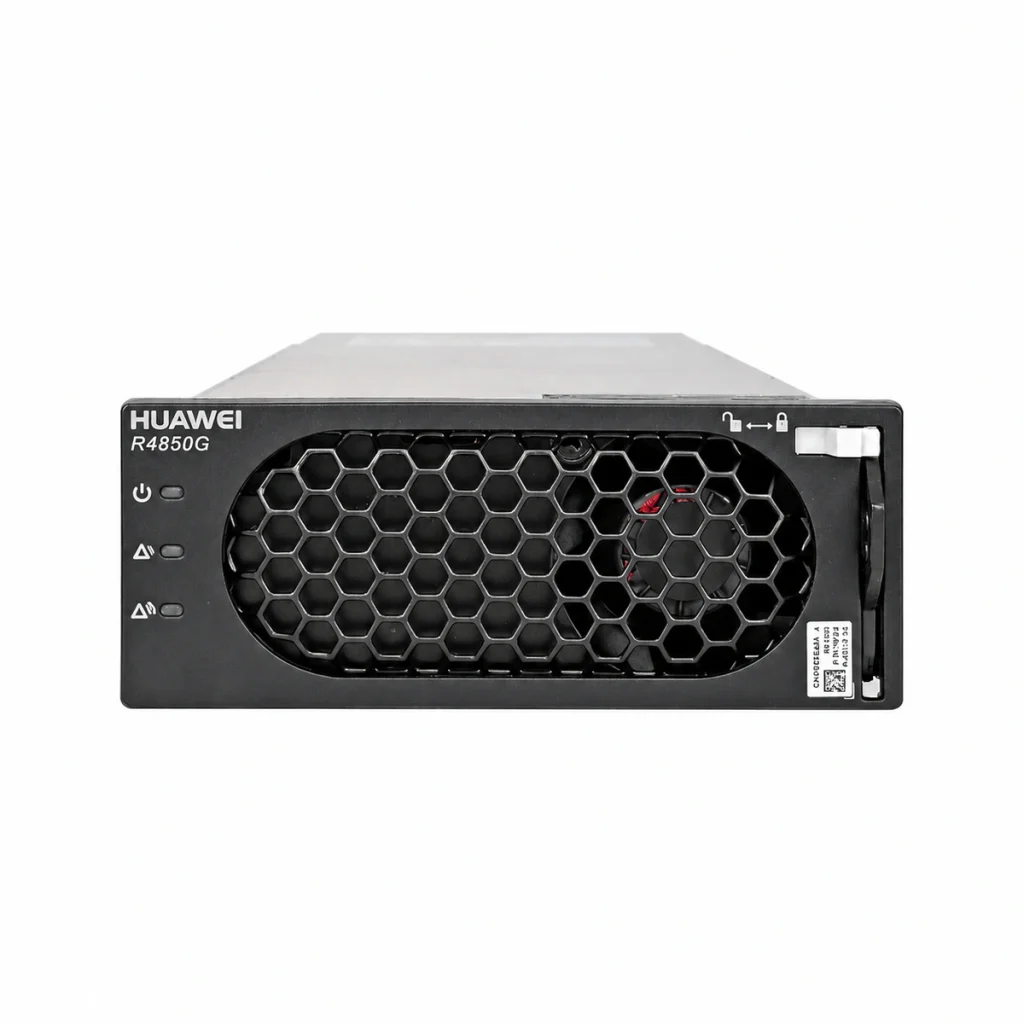
If you have ever stood in front of a 48V telecom cabinet trying to decide between Huawei R4850 and Vertiv R48 modules, you already know the answer is rarely about the module itself. The cabinet, the controller, the monitoring protocol, your existing spares pool, the regional service network, and your procurement team’s familiarity with the platform all matter more than the 2 percentage point efficiency difference. This guide is written from the perspective of a procurement engineer choosing between the two for a new build or an expansion. We will compare the current production flagships — Huawei R4850G6 and Vertiv R48-3000E3 — and walk through the deployment scenarios we see most often across Europe, the Middle East, Africa, South America and Russia.
Why this comparison matters in 2026
The 48V rectifier market is a duopoly in practice. Two platforms — Huawei TP48xxx with R4850 modules, and Vertiv (formerly Emerson) NetSure 731 / NetSure 2100 with R48 modules — account for the majority of new telecom power deployments outside North America. North America has its own ecosystem (Alpha, Eltek, GE), and we will touch on Eltek briefly because our cross-reference chart covers all four brands. But for the regions we serve, the procurement decision is almost always: Huawei or Vertiv?
The choice matters because it is a 5 to 10 year capex commitment. Once you standardize on TP48xxx cabinets with R4850 modules, you cannot drop in an R48 module later. The backplane, controller protocol, and monitoring connector are all proprietary. Standardizing on the wrong platform means higher spare-parts cost, harder technician hiring, and longer MTTR. We see this most painfully when an operator standardizes on Huawei in one country and Vertiv in a neighbouring country — they end up carrying two complete spares pools, two NOC platforms, and two technician training programs.
Geographically, the split is fairly clean. Huawei R4850 / TP48xxx dominates Africa, the Middle East, and most of South America (Brazil, Colombia, Chile). Vertiv NetSure 731 with R48 modules dominates Europe, Russia and the CIS, and is also strong in enterprise colocation and edge data center builds everywhere. If you walk into an MTN switching centre in Lagos, you will see TP48200B cabinets with R4850 modules. If you walk into a MegaFon switch in Moscow, you will see NetSure 731 A41 cabinets with R48-3000E3 modules.
The exception is hybrid sites — edge data centers, FTTH OLT sites, and small cell backhaul nodes — where the brand decision is often made by the equipment vendor (Cisco, Nokia, Ericsson) rather than the power team. In those cases the brand is whatever the OEM bundle specified.
Side-by-side specifications: R4850G6 vs R48-3000E3
Below is the comparison we use internally when a customer asks “which one should I standardize on?”. Both are 3000W modules, fan-cooled, hot-swappable, with peak efficiencies above 96%. The numbers are from the brand datasheets plus our own lab verification on units shipped from our Shenzhen warehouse.
| Specification | Huawei R4850G6 | Vertiv R48-3000E3 |
|---|---|---|
| Output power | 3000 W | 3000 W |
| Output voltage | -48 VDC (42–58 VDC adjustable, 53.5 VDC default) | -48 VDC (42–58 VDC adjustable, 53.5 VDC default) |
| Output current | 62.5 A max | 62.5 A max |
| Input voltage | 176–300 VAC (full power) / 90–176 VAC (derated) | 176–277 VAC (full power) / 85–176 VAC (derated) |
| Power factor | ≥ 0.99 at 50% load and above | ≥ 0.99 at 50% load and above |
| Peak efficiency | 96.5% at 50% load | 96.5% at 50% load |
| Efficiency at 70% load | 96.0% | 95.8% |
| Cooling | Forced-air fan (variable speed, hot-swappable fan module) | Forced-air fan (variable speed) |
| Hot-swap | Yes (no break, <10 ms transfer) | Yes (no break, <10 ms transfer) |
| Weight | 2.2 kg | 2.0 kg |
| Dimensions (W × H × D) | 105 × 132 × 281 mm | 105 × 132 × 269 mm |
| MTBF | 250,000 hours | 200,000 hours |
| Operating temperature | -40°C to +75°C (derated above 55°C) | -40°C to +75°C (derated above 65°C) |
| Audible noise | ≤ 55 dB at full load | ≤ 55 dB at full load |
| Communication | CAN bus to Huawei controller (SMU01C / SMU02C) | CAN bus to Vertiv controller (M225S / M830S) |
| Cabinet compatibility | Huawei TP48200B / TP48300B / TP48400B / TP48600B | Vertiv NetSure 731 A41 / A91, NetSure 2100 |
| Certifications | CE, UL, CCC, KCC, RCM | CE, UL, CCC, EAC |
| Standard warranty | 2 years (extendable to 5) | 2 years (extendable to 5) |
Legacy note: Older Huawei R4850G2 modules (produced 2016 and earlier) fit the same TP48xxx cabinet backplane and remain a common search term for buyers migrating from legacy sites. The R4850G2 is no longer in current production stock; if you need a drop-in replacement for an R4850G2 slot, the R4850G6 listed above is mechanically and electrically compatible with the TP48200B, TP48300B, TP48400B and TP48600B cabinets. Ask our team to confirm cabinet firmware revision before ordering large quantities as a G2-to-G6 swap.
Two things stand out from the table. First, the two modules are within 0.5 percentage points of each other on efficiency at every load point we measured — there is no meaningful efficiency argument for choosing one over the other. Second, the MTBF rating differs by 50,000 hours (250,000 vs 200,000). In field terms, that is roughly 1.5 years of additional service life expectancy. It matters at sites where replacement is hard (submarine cable landing stations, mountaintop microwave sites, rural Africa macro sites) but does not matter at sites with easy truck access.
For the Huawei R4850G6 product page we maintain a current stock list and the latest factory test report. Same for the Vertiv R48-3000E3 product page. Both are in stock at our Shenzhen warehouse as of this writing.
Cabinet ecosystem: the real reason brand matters
A rectifier module is only half the picture. The cabinet — backplane, controller, monitoring interface, breaker layout, battery shelf — is the other half. This is where the two ecosystems diverge completely.
Huawei TP48xxx ecosystem
The Huawei indoor power cabinet family is the TP48xxx series. The four standard sizes cover 90% of deployments:
- TP48200B-N20B2 200A cabinet — fits 4 rectifier slots, 200A total output, suits small cell and FTTH OLT sites
- TP48300B-N04C2 300A cabinet — 6 rectifier slots, 300A output, suits standard 3-sector 4G/5G macro sites
- TP48400B-N20B3 400A cabinet — 8 rectifier slots, 400A output, suits dense urban 5G sites and small edge data centers
- TP48600B-N20B1 600A cabinet — 12 rectifier slots, 600A output, suits core switching centers and large 5G hub sites
The TP48xxx family uses Huawei’s SMU01C or SMU02C controller, which talks to the rectifier modules over CAN bus. The same controller also handles battery management, load shedding, dry-contact alarms, and SNMP/Modbus/Ethernet uplink. The monitoring dashboard is Huawei NetEco — a cloud platform that is widely deployed at operator NOCs across Africa, the Middle East, and South America. If your NOC already runs NetEco, you want TP48xxx cabinets with R4850 modules.
Vertiv NetSure ecosystem
The Vertiv platform is built around the NetSure 731 A41/A91 cabinet family and the newer NetSure 2100 series. The NetSure 731 is the workhorse of European and Russian telecom — 300A and 600A standard configurations, with the M225S or M830S controller handling rectifier communication over CAN bus. The monitoring dashboard is Vertiv Netsure Connect, which is widely deployed across Europe and the CIS.
If you walk into a MegaFon switch in Moscow or a Deutsche Telekom aggregation node in Berlin, you will see NetSure 731 A41 cabinets with R48 modules. The brand decision was made years ago, the spares pool is in place, and the NOC is already trained on Netsure Connect.
Cross-compatibility: there is none
We get asked “can I use an R4850 module in a NetSure 731 cabinet?” at least once a week. The answer is no. The mechanical form factor is similar but not identical (281 mm vs 269 mm depth), the backplane pinout is different, and the controller cannot read the module telemetry without the proprietary handshake protocol. Attempting cross-mounting usually damages the backplane connector and voids the cabinet warranty. We strongly recommend against it.
If you need cross-reference information — for example, you are migrating from NetSure 731 to TP48200B and want to know which R48-3000E3 module to pull out and which R4850G6 to stock as a replacement — see our 48V rectifier cross-reference chart for the full mapping across Huawei, Vertiv, Eltek, ZTE and Delta.
Pricing, lead time, and warranty in 2026
Both R4850G6 and R48-3000E3 are mature products with stable pricing. Through BS Comtec’s authorized distribution channels in 2026, the per-module price at 1 to 4 unit quantity is comparable — within 5 to 8% of each other. At 10+ unit volume, the Vertiv R48-3000E3 typically carries a 3 to 5% brand premium over Huawei R4850G6, reflecting Vertiv’s EU manufacturing footprint and stronger IP position in Europe.
Lead time is 3 to 5 business days for either module from our Shenzhen warehouse. Both are kept in stock year-round. If you need an urgent order with air freight, we can dispatch same-day with DHL or FedEx — add 5 to 7 days for door-to-door delivery to most Africa and Middle East destinations, 3 to 5 days to EU and South America.
Standard warranty is 2 years on both modules, extendable to 5 years with a brand-backed service contract. Warranty follows the manufacturer’s policy — we provide original factory warranty documentation with every shipment and coordinate RMA directly with the brand’s regional service center if a failure occurs.
Decision matrix by use case
The table below is what we hand to customers when they ask “which one?”. The decision is rarely about the module itself — it is about the cabinet, the NOC platform, the regional service network, and the existing spares pool.
| Use case | Recommended platform | Why |
|---|---|---|
| Africa mobile operator macro site (MTN, Airtel, Safaricom, etc.) | Huawei R4850G6 + TP48xxx cabinet | Standardized across the operator’s existing network. Spares pool, NOC platform (NetEco), and field technician skills all in place. Lead time and pricing optimized for Africa. |
| EU enterprise data center / colocation | Vertiv R48-3000E3 + NetSure 731 | Vertiv has the strongest EU service network. Netsure Connect is the standard NOC platform for EU enterprise DC ops teams. |
| Russia / CIS operator macro site (MegaFon, MTS, Beeline) | Vertiv R48-3000E3 + NetSure 731 | Standardized across the operator’s network. Local EAC certification. Strong in-country service partner network. |
| Middle East 5G rollout (STC, Etisalat, Zain) | Huawei R4850G6 + TP48xxx cabinet | Huawei is the dominant 5G RAN vendor in the Middle East, so the power platform naturally standardizes on TP48xxx. Single-vendor bundle simplifies SLAs. |
| Edge data center (5–50 kW) | Either — depends on the bundle | Edge DC sites are often tied to the IT vendor (Cisco, Nokia, Ericsson). Match the rectifier platform to whatever the IT bundle specifies. Our edge DC 48V power guide covers this in more depth. |
| FTTH OLT site (urban) | Either — TP48200B vs NetSure 731 small frame | Small frame sizes are interchangeable. Pick whichever platform your regional service partner stocks locally. |
| Off-grid solar hybrid telecom (Africa, Middle East) | Huawei R4850G6 + TP48xxx | The off-grid architecture (covered in our off-grid solar hybrid guide) uses the same TP48xxx cabinet as grid sites, so spares and NOC integration are common. |
Decision tree: which one should you actually buy?
If you have read this far, the answer is probably already clear. But here is a one-page decision tree that summarizes the path:
- Is your existing cabinet Huawei TP48xxx?
→ Yes → Standardize on Huawei R4850G6. Source from BS Comtec’s Shenzhen stock.
→ No → Go to step 2. - Is your existing cabinet Vertiv NetSure 731 or NetSure 2100?
→ Yes → Standardize on Vertiv R48-3000E3. Source from BS Comtec’s Shenzhen stock.
→ No → Go to step 3. - Is this a greenfield site with no existing cabinet?
→ Yes → Look at the IT/RAN bundle. If the bundle specifies Huawei, go TP48xxx + R4850G6. If Vertiv, go NetSure 731 + R48-3000E3. If the bundle is brand-neutral, see step 4.
→ No → You have an existing cabinet from another brand (Eltek, ZTE, Delta). Stay with that brand for rectifier and cabinet compatibility. See the cross-reference chart for migration paths. - Greenfield site, brand-neutral bundle. Which region?
→ Africa / Middle East / South America → Default to Huawei R4850G6 + TP48xxx.
→ Europe / Russia / CIS → Default to Vertiv R48-3000E3 + NetSure 731.
BS Comtec stock and how to RFQ
As of September 2026, both Huawei R4850G6 and Vertiv R48-3000E3 are in stock at our Shenzhen warehouse. We also stock the TP48400B 400A cabinet and the TP48200B 200A cabinet for greenfield deployments.
For an RFQ, send us your cabinet type, rectifier count, battery backup requirement, and destination port. We respond with same-day quote including reference price, lead time, and shipping options (CIF / FOB / EXW). All shipments include original factory warranty documentation and the BS Comtec test report for every module.
For larger deployments (10+ modules or full cabinet builds), our engineering team can review your single-line diagram and recommend the optimal rectifier count for N+1 redundancy, the right battery capacity for your backup runtime target, and the right cabinet size for your load profile.
FAQ — Huawei R4850 vs Vertiv R48 Selection
FAQ — Huawei R4850 vs Vertiv R48 Selection
Q: Can I use R4850 in a NetSure 731 cabinet?
A: No. Huawei R4850 series and Vertiv R48 series use different mechanical form factors, backplane pinouts, and proprietary controller protocols. R4850 fits Huawei TP48xxx cabinets only (TP48200B, TP48300B, TP48400B, TP48600B). R48 series fits Vertiv NetSure 731 A41/A91 and NetSure 2100 systems. We have seen customers lose money trying to cross-mount modules because the connectors do not align and the controller cannot read the module telemetry.
Q: Which has better efficiency, R4850 or R48?
A: For current production modules, Huawei R4850G6 and Vertiv R48-3000E3 both reach 96.5% peak efficiency at 50% load. Above 70% load the R4850G6 holds 96.0% while the R48-3000E3 holds 95.8%. The 0.2 to 0.7 percentage point gap translates to roughly 50 to 180 kWh per rectifier per year at a 5 kW site. At a 1,000-site network, that is 50 to 180 MWh per year of waste heat that your cooling system has to remove.
Q: What is the typical lifespan of these rectifiers?
A: 10 to 15 years with proper maintenance in a temperature-controlled environment. The rectifier itself rarely fails — fans die at year 7 to 10, electrolytic capacitors drift at year 10 to 12. Our recommendation is to budget fan replacement at year 8 and full module replacement at year 12 for sites that have already seen two capacitor seasons. Africa and Middle East sites with high ambient temperatures often see fan failure 2 years earlier than EU sites.
Q: Are spare parts interchangeable between Huawei and Vertiv?
A: No. The rectifier module is a sealed unit — you do not service the PCB. Fans and front-panel displays are brand-specific. Even the monitoring connector pinout differs between TP48xxx and NetSure 731. Keep at least 2 spare modules per cabinet and 1 spare controller per site, sourced from the same brand as the cabinet.
Q: Which is more common in Africa?
A: Huawei R4850 and the TP48xxx cabinet family dominate Africa and the Middle East — they are the standard MTN, Airtel, Safaricom, Etisalat, STC deployment. If you are building or expanding a mobile network in Lagos, Nairobi, Cairo, Riyadh or Johannesburg, your team will already know the TP48xxx platform, your spares pool will already include R4850 modules, and your NOC will already run Huawei NetEco. Vertiv R48 and NetSure 731 are present in Africa mainly at enterprise and colocation sites, not operator macro sites.
Q: How do I verify the rectifier is original?
A: Three checks. First, the nameplate sticker must show a QR code or 16-digit serial that resolves on the brand’s official verification portal (Huawei eSight or Vertiv PowerProtect). Second, the module weight should be within 5% of the brand’s published spec (R4850G6 is 2.2 kg; R48-3000E3 is 2.0 kg) — counterfeits are usually 10 to 15% lighter. Third, request the original factory test report from your supplier; BS Comtec provides this as standard with every R4850G6 and R48-3000E3 shipment.
Q: What is the difference between the R4850G6 and R4850G5 rectifier modules?
A: The Huawei R4850G6 is the successor to the R4850G5, with both being 48 V / 3 kW rectifier modules for telecom power systems. The G6 generation offers improved peak efficiency (up to 96 %) and a wider operating temperature range compared to the G5, reducing cooling requirements in outdoor cabinets. Both share the same physical form factor and are compatible with the same 19-inch rack shelves, so upgrading from G5 to G6 typically requires only a module swap. The R4850G5 remains widely deployed and cost-effective for existing sites. See the R4850N2 product page for current specifications and availability.
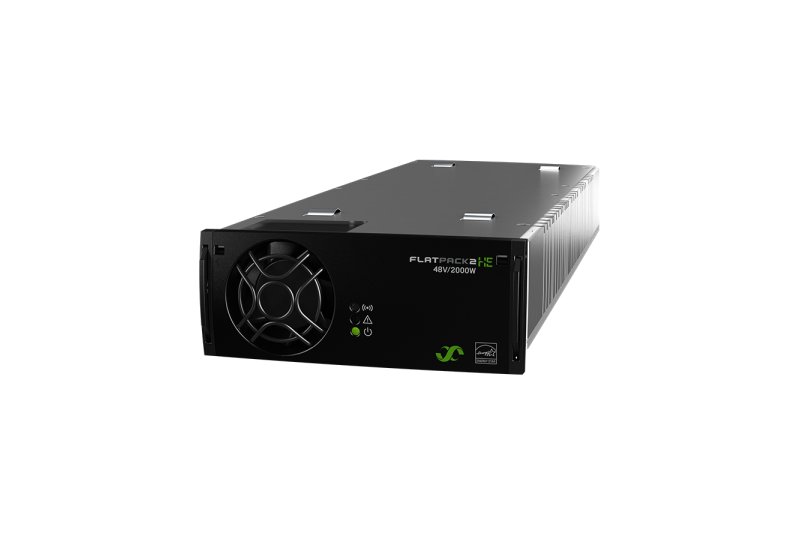
Q: Can the Eltek Flatpack2 connect to BMS batteries?
A: Yes, the Eltek Flatpack2 can communicate with battery management systems through the Smartpack controller or an external CAN/RS485 interface. The controller reads BMS parameters — state of charge, temperature, max charge/discharge current — and adjusts the rectifier output voltage accordingly, which is essential for protecting lithium battery packs from over-charge and deep discharge. In a typical installation the Flatpack2 modules sit in a shelf connected to the Smartpack, and the Smartpack talks to the BMS via CAN bus. For sites using lead-acid batteries the BMS link is optional. See the Flatpack2 product page for interface details.
Last updated: September 2026. Specifications verified against current production units in BS Comtec Shenzhen stock. For an RFQ or cabinet compatibility review, contact our engineering team via the product page or WhatsApp +86 135 8237 6986.
Q: How does Eltek SmartPack controller work with BMS?
The Eltek SmartPack controller communicates with Battery Management Systems (BMS) via CAN bus or RS485 protocols, monitoring cell voltage, temperature, and state of charge in real time. It adjusts charging voltage and current limits based on BMS feedback, preventing overcharge and deep discharge. Key integration points include: SOC-based charge profile switching, temperature compensation for float voltage, and alarm relay output for BMS fault conditions. For Eltek Flatpack2 systems with SmartPack, ensure firmware compatibility between the controller and your BMS model. Contact our team via WhatsApp (+86 135 8237 6986) for integration guides.
See also: Huawei R4850G5.
See also: Huawei R4850N1.
See also: Huawei R4875G1.
See also: Vertiv R48-3500E4.