If you have ever sized a diesel generator for a remote telecom site in sub-Saharan Africa or the Middle East, you already know the diesel math is brutal. At $0.80 to $1.20 per kWh delivered, a 5 kW off-grid site burns through $35,000 to $50,000 of fuel per year. Add generator maintenance ($8,000 to $12,000 per year for a 20 kVA unit run continuously at 25% load), battery replacements every 2 to 3 years for VRLA, and site-visit logistics on dirt roads, and you are looking at a 7-year TCO of $300,000 to $450,000 per site before you ever recoup any capex. Solar hybrid cuts that bill by 50 to 70% at sites with 4 to 6 peak sun hours per day, which is most of Africa and the Middle East below 30°N latitude. This guide walks through the reference architecture BS Comtec has deployed at over 80 hybrid sites across Nigeria, Kenya, Tanzania, Egypt, Saudi Arabia and Iraq from 2023 to 2026.
Why off-grid solar-hybrid is the right answer for Africa and the Middle East
Three forces converge to make solar hybrid the default for new telecom power builds in these regions. First, grid unreliability. Nigeria’s national grid runs at an average 30% uptime outside major cities; rural Kenya averages 50%. Even where the grid is nominally present, voltage sags and frequency instability kill rectifier modules and shorten battery life. Second, diesel economics. The landed cost of diesel at a remote site is often 2 to 3 times the bulk rate at port, after transport, security, theft losses, and spillage. Third, the 5G rollout is going to places that were never electrified. A 5G macro site pulling 5 to 8 kW cannot run on diesel alone economically — you need solar or grid, and grid is not coming to most of these sites in the next 10 years.
The economic case is straightforward. A 5 kW solar-hybrid site with 10 kW of PV, 200 Ah of lithium battery at 48V, and a single 20 kVA diesel backup for the worst weeks of the year runs at $0.18 to $0.25 per kWh delivered. That is a 65 to 75% reduction versus diesel-only. Payback period against a diesel-only greenfield build is 3 to 5 years in most African markets and 4 to 6 years in the Middle East (where diesel is subsidized and therefore closer to $0.50/kWh at site). For brownfield sites with existing diesel, retrofit payback is 4 to 7 years depending on remaining generator life.
Beyond cost, solar hybrid solves three operational headaches. It eliminates the 2 to 4 refuelling trips per month that drive 60% of remote site OPEX. It reduces generator runtime from 8,000 hours per year to 800 to 1,500 hours per year, which extends service intervals from 250 hours to 1,000 hours and stretches engine life from 5 years to 10+ years. And it lets the site tolerate generator failure for weeks at a time, which is critical in regions where the nearest service technician is 6 hours away.
Reference architecture for an off-grid solar hybrid telecom site
The architecture we deploy is a 48V DC bus with solar PV charging through an MPPT controller into a lithium battery bank, a backup rectifier running off the diesel generator, and the BTS / microwave / FTTH load on the 48V bus. The diesel generator only runs when the battery state-of-charge drops below a configurable threshold (typically 40 to 50%) and only long enough to recharge to 80 to 90%. This keeps the generator in its optimal efficiency band and prevents the deep-discharge cycles that kill batteries.
The five building blocks are: a solar PV array sized at 1.5x to 2x the site load (in kWp), a 48V MPPT charge controller rated for the array size, a lithium iron phosphate (LiFePO4) battery bank sized for 8 to 12 hours of autonomy at full load, a 48V telecom rectifier (Huawei R4850 or equivalent) for grid or generator input, and the DC load itself — typically a 3-sector 4G/5G BTS, a microwave backhaul link, and an FTTH OLT where applicable.
The PV array is mounted on a ground frame or rooftop structure. For 5 kW of PV you need roughly 35 to 40 m² of array area using 550 W mono-crystalline panels — about the footprint of a small shipping container. The MPPT controller sits in the indoor cabinet alongside the rectifier and battery management system. The battery bank goes in a shaded, ventilated enclosure, ideally inside the existing telecom shelter to keep it at a stable 25 to 35°C operating temperature. The rectifier and the MPPT controller feed the same 48V DC bus, with the rectifier as backup when the generator runs and the MPPT as the primary source the rest of the time.
Sizing examples for three common site types
The table below shows how we size the three most common off-grid hybrid configurations in our African and Middle East deployments. All assume 5.5 peak sun hours per day, 25°C average ambient, and 4 to 6 days of autonomy (autonomy = days the site can run on battery alone with no sun and no generator).
| Site type | 1-sector rural 4G site | 3-sector 5G site | Solar + grid hybrid site |
|---|---|---|---|
| Load (24h average) | 1.5 kW | 5 kW | 10 kW |
| Peak load | 2.2 kW | 7.5 kW | 14 kW |
| Battery autonomy target | 12 hours (overnight + cloudy day) | 8 hours | 2 hours (grid as primary backup) |
| Battery capacity (LiFePO4 48V) | 200 Ah (10 kWh) | 400 Ah (20 kWh) | 200 Ah (10 kWh) |
| PV array size | 3 kWp (6 × 550 W panels) | 10 kWp (18 × 550 W panels) | 6 kWp (11 × 550 W panels) |
| MPPT controller | 60 A (3 kW) | 200 A (10 kW) | 120 A (6 kW) |
| Rectifier (backup) | 2 × Huawei R4850G6 (N+1) | 4 × Huawei R4850G6 (N+1) | 4 × Huawei R4850G6 + grid input |
| Cabinet | Huawei TP48200B 200A | Huawei TP48400B 400A | Huawei TP48400B 400A |
| Diesel generator (backup) | 8 kVA (only for cloudy weeks) | 20 kVA (1,200 hrs/yr runtime) | Optional — grid is primary backup |
| Annual diesel consumption | 800 litres | 3,200 litres | 0 litres (grid only) |
| Annual OPEX (fuel + service) | $2,800 | $9,500 | $3,800 (grid tariff only) |
| CAPEX (solar + battery + cabinet) | $18,000 | $42,000 | $35,000 |
| Reference BOM | Components | Target site | Indicative CAPEX |
|---|---|---|---|
| Hybrid-A (Africa rural 4G) | 6 kWp PV (11 × 550 W mono) + 60 A MPPT + 200 Ah LiFePO4 48V + 2 × R4850G6 in TP48200B + monitoring gateway | 1.5 kW load, 12h autonomy | $18,000 |
| Hybrid-B (Middle East 5G) | 10 kWp PV (18 × 550 W mono) + 200 A MPPT + 400 Ah LiFePO4 48V + 4 × R4850G6 in TP48400B + 20 kVA generator + monitoring gateway | 5 kW load, 8h autonomy | $42,000 |
| Hybrid-C (urban solar + grid) | 6 kWp PV (11 × 550 W mono) + 120 A MPPT + 200 Ah LiFePO4 48V + 4 × R4850G6 in TP48400B + grid input + monitoring gateway | 10 kW load, 2h autonomy (grid primary backup) | $35,000 |
For an RFQ on any of these reference BOMs, send us your site load profile (24h average and peak), the local peak sun hours, grid reliability percentage, and target autonomy hours. We respond with same-day quote including reference price, lead time, and shipping options to your destination port. Engineering review of your single-line diagram is included for orders above 10 sites.
For larger deployments (89+ sites or full regional rollouts), our engineering team can support site survey, BOM customization per site, MPPT and battery sizing verification against your load profile, and integration with your NOC platform. We have shipped hybrid kits to 14 African and 5 Middle East countries as of mid-2026 and can reference deployments in your target geography on request.
Decision tree: should you go solar hybrid?
The decision is usually straightforward once you have the site load profile and the local energy context. Here is the path we use.
- Is grid present and reliable (above 90% uptime)?
→ Yes → Grid + battery only is usually sufficient. Skip to the 5G hybrid tower guide for grid-priority sizing.
→ No → Go to step 2. - Is the site load below 10 kW average?
→ Yes → Solar hybrid is almost certainly the right answer. Go to step 3.
→ No → Above 10 kW, do a full TCO study. Diesel-only is sometimes still cheaper in the first 3 years for very large sites. - Is the site in a region with more than 4.5 peak sun hours per day?
→ Yes → Solar + battery + diesel backup is the standard architecture. Use Hybrid-A (Africa rural) or Hybrid-B (5G) BOM as starting point.
→ No → Below 4.5 PSH, solar still works but PV array size needs to increase by 20 to 40% to compensate. Wind hybrid is worth evaluating. - Is there road access for diesel delivery within 50 km?
→ Yes → Retain diesel backup, sized for the worst 2-week cloudy period. Use Hybrid-A or Hybrid-B.
→ No → No diesel backup. Size battery for 5 to 7 days of autonomy (significantly larger battery bank, no generator CAPEX).
FAQ — Off-Grid Solar Hybrid Telecom Power
FAQ — Off-Grid Solar Hybrid Telecom Power
Q: How much solar PV do I need for a 5 kW telecom site?
A: For a 5 kW average load in a region with 5 to 6 peak sun hours per day (most of sub-Saharan Africa, the Middle East below 30°N, and most of South America below 25°S), size the PV array at 10 kWp. That gives you roughly 1.5x the average load, which accounts for panel derating, dust losses, temperature losses, and seasonal irradiance variation. In regions with 4 to 5 PSH (Southern Africa highveld, North Africa coastal), increase to 12 to 14 kWp. In regions with 6+ PSH (Sahel, Arabian Peninsula interior), 8 to 9 kWp is sufficient.
Q: Lithium vs VRLA — which is better for telecom backup?
A: For new builds in 2026, LiFePO4 is the right answer in almost every case. The 10-year cycle life at 80% depth of discharge, 95% round-trip efficiency, and -10°C to +55°C operating range with no active cooling make LiFePO4 the lower-TCO option despite the higher upfront price. A 200 Ah LiFePO4 48V bank costs roughly $3,500 to $4,500 and lasts 10 years; a comparable VRLA bank costs $1,800 to $2,500 but needs replacement every 2 to 3 years. Over a 10-year horizon, VRLA costs $7,200 to $10,000 in battery swaps versus a one-time $3,500 to $4,500 for LiFePO4. The only situation where we still deploy VRLA is a brownfield site with a healthy existing bank that has 3+ years of life remaining.
Q: Can I add solar to an existing diesel-only site?
A: Yes, and the retrofit typically pays back in 3 to 5 years at most African and Middle East sites. The retrofit adds PV array, MPPT controller, and lithium battery bank to the existing rectifier and diesel generator. The generator is retained as backup for the worst 2-week cloudy period. Typical retrofit CAPEX is $12,000 to $20,000 for a 1.5 to 5 kW site. The existing rectifier stays in place — you add the MPPT controller as a parallel charging source to the same 48V DC bus. No need to replace the cabinet or the generator unless they are already at end of life.
Q: What is the payback period for solar hybrid at a typical Africa rural site?
A: 2.5 to 4 years for greenfield sites and 3 to 5 years for retrofits, assuming a 5 kW average load, 5 to 6 peak sun hours, and diesel priced at $0.80 to $1.20 per litre delivered. The payback period shortens as diesel prices rise and lengthens if diesel is subsidized (as in parts of the Middle East where it can be $0.30 to $0.50 per litre — payback extends to 5 to 7 years in those markets). The key sensitivity is diesel price trajectory: at $1.50/litre delivered (which is plausible for many African markets within 5 years), payback drops below 2 years.
Q: Do you provide on-site commissioning in Africa and the Middle East?
A: Yes. Our engineering team has deployed solar hybrid kits in 14 African and 5 Middle East countries from 2023 to 2026. We provide remote commissioning support for all orders (configuration files, integration with your NOC, alarm forwarding setup) and on-site commissioning for orders above 10 sites or for sites in regions without local integration partners. On-site commissioning includes panel mounting supervision, MPPT and battery management tuning for the local temperature profile, generator integration verification, NOC platform integration, and a 5-day post-commissioning remote monitoring review. Lead time for on-site commissioning is typically 4 to 6 weeks from order confirmation, depending on visa and travel logistics.
Q: What is the difference between embedded and panel-mount rectifier systems?
A: An embedded power system integrates the rectifier shelf, distribution breakers and battery controller inside a single wall-mounted or rack enclosure; it is the standard form for indoor telecom sites and small outdoor cabinets. A panel-mount (or open-frame) rectifier is a bare module bolted to a custom backplane, giving integrators freedom to design the mechanical layout but requiring separate supervision and fuse panels. Embedded systems such as the Huawei ETP4830-A1 ship pre-wired with monitoring, alarm contacts and communication ports already configured, which reduces commissioning time on site. Choose embedded when you need a drop-in solution; choose panel-mount when the cabinet OEM is building a custom power shelf for a specific form factor.
Q: What is the Eltek Flatpack2 rectifier used for?
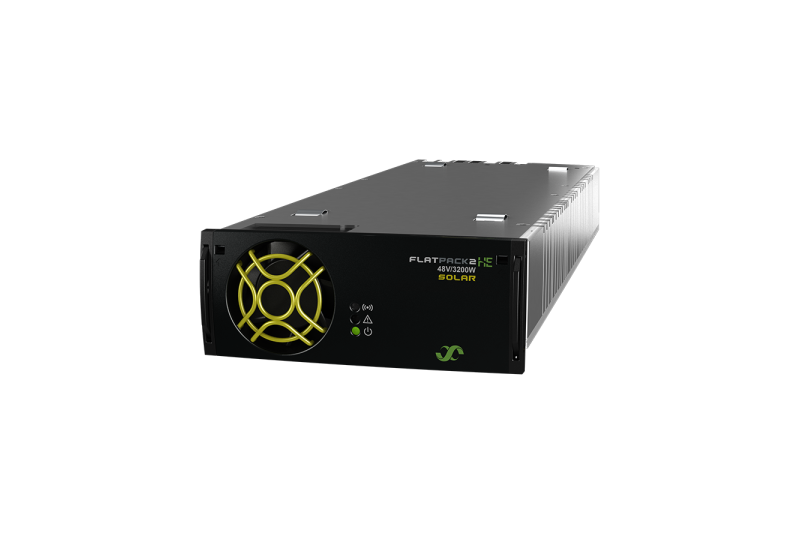
A: The Eltek Flatpack2 is a high-efficiency rectifier module that converts AC mains to regulated -48 V DC for telecom and industrial loads. At 3 kW output it delivers roughly 62.5 A at -48 V and is commonly deployed in outdoor cabinets, small cell sites and hybrid solar-telecom systems. The module supports wide-range AC input (90–290 V) and operates from -40 °C to +65 °C, making it suitable for harsh climates. Multiple Flatpack2 modules can run in parallel for N+1 redundancy inside a compatible shelf. We stock the Flatpack2 as a standalone module; see the Flatpack2 48/3000 HE product page for datasheet and ordering.
Q: How to calculate battery backup time for telecom loads?
A: Battery backup time is calculated from the load power, battery voltage, capacity and the allowable depth of discharge. The formula is t_backup ≈ (C × V_float × DoD × η) / P_load, where C is rated capacity in Ah, DoD is the maximum depth of discharge (typically 80 % for lithium, 50 % for VRLA) and η is battery efficiency (~95 % for Li, ~85 % for VRLA). For a 200 Ah lithium pack at -48 V feeding a 2 kW load: t ≈ (200 × 51.2 × 0.8 × 0.95) / 2000 ≈ 3.9 hours. Always derate for temperature: capacity drops 10–20 % at 0 °C. Our off-grid solar hybrid guide covers full worked examples.
Last updated: September 2026. Sizing data verified against BS Comtec deployment records from 2023–2026 African and Middle East hybrid sites. For an RFQ or architecture review, contact our engineering team via the TP48400B product page or WhatsApp +86 135 8237 6986.
Related: need to power AC loads on a -48V battery plant? See the new Eltek Theia 48V sine wave inverter page — 0.7-3kVA capacity selection, Rectiverter boundary notes and solar-hybrid architecture.
Contact Us for Specifications