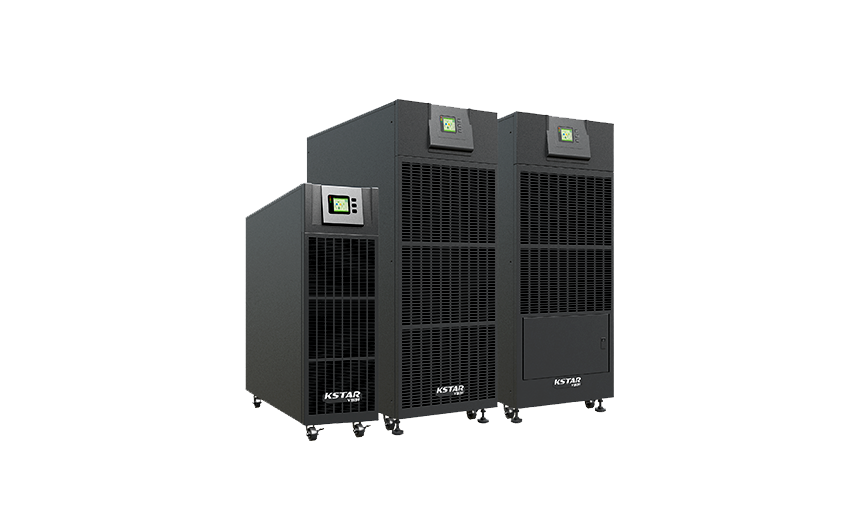
Buyers in the 50–200 kVA range usually compare two architectures before signing a purchase order: a high-capacity tower UPS like the KSTAR YDC3300, or a modular UPS platform such as the Huawei UPS5000-E family. The two approaches solve the same problem — protecting critical loads — but with different trade-offs in input window, efficiency, scalability and battery architecture. This article compares them using published YDC3300 specifications and publicly known modular-UPS concepts, without inventing figures for either side.
KSTAR YDC3300: published specifications at a glance
| Item | KSTAR YDC3300 (50–200 kVA) |
|---|---|
| AC input window | 138–485 VAC wide range |
| Input degradation | No derating at load ≥305 VAC |
| Topology | Three-level (NPC) high-frequency design |
| Efficiency | 95.5% double conversion / up to 99% in ECO mode |
| Parallel capacity | Up to 6 units with shared battery group |
| Output power factor | 1.0 |
| Phase unbalance | 100% three-phase unbalanced load capability |
| Battery compatibility | VRLA and lithium battery |
| Synchronization | LBS (Load Bus Synchronization) support |
Tower UPS vs modular UPS: the architectural difference
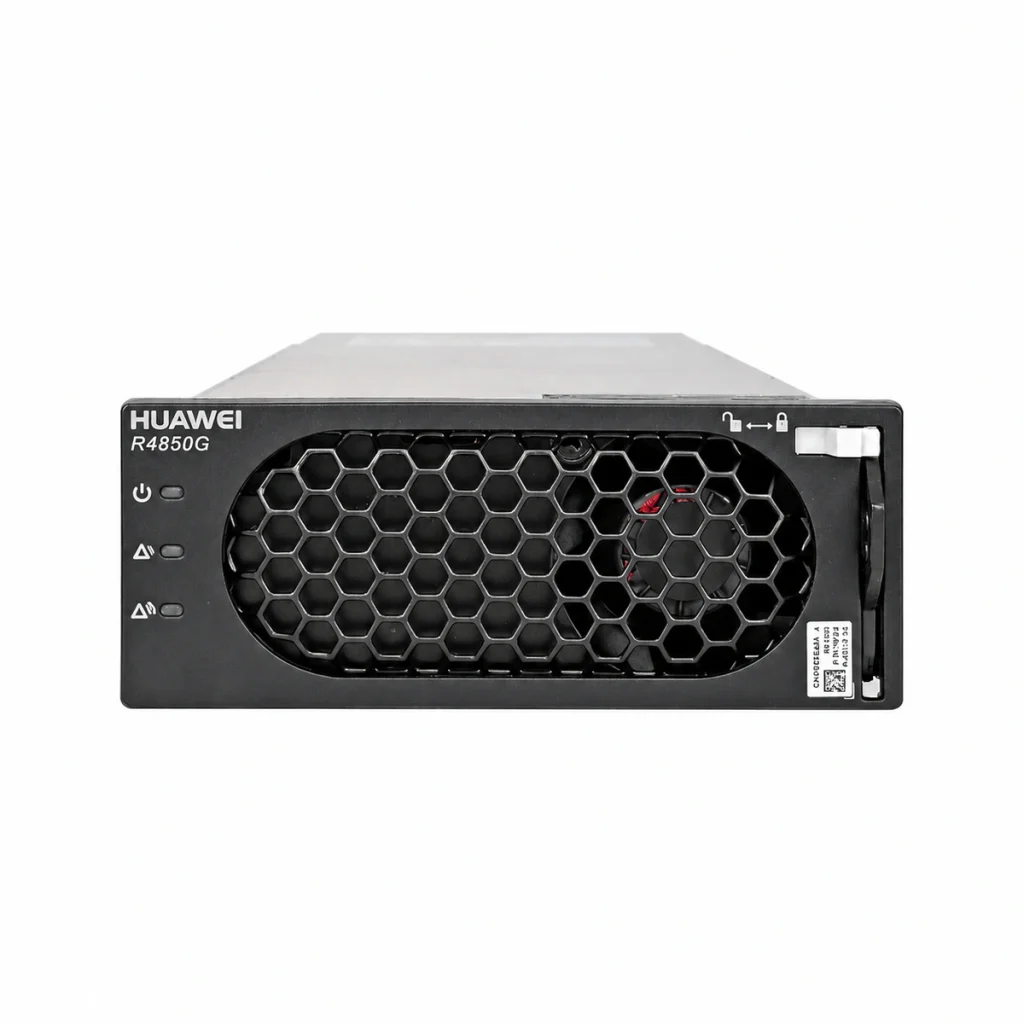
A tower UPS like the YDC3300 is delivered as a complete frame with a fixed capacity rating (50–200 kVA in this series). Capacity planning is done at purchase time, and redundancy is achieved by paralleling complete frames. A modular UPS platform — the concept behind the Huawei UPS5000-E family — puts capacity into hot-swappable power modules inside one cabinet: you start with the modules you need today and add more as load grows, with module-level redundancy. Neither approach is universally better; they optimize for different project profiles.
Where the YDC3300 stands out
- Harsh grids and generator sites: the published 138–485 VAC input window with no derating from 305 VAC upward tolerates weak grids and generator fluctuations common in African, Middle East and Latin American sites.
- Full kVA delivery: output power factor 1.0 means the rated kVA converts to real kW capacity for modern IT and mixed loads.
- Unbalanced loads: 100% three-phase unbalanced load capability helps sites with single-phase-heavy distribution.
- Shared battery paralleling: up to 6 YDC3300 units can parallel while sharing one battery group — fewer battery strings for the same autonomy.
- Lithium-ready: VRLA and lithium compatibility on the same platform, plus LBS for multi-system synchronization.
Where a modular UPS wins
- Uncertain growth: data centers and edge sites that expect staged expansion avoid overbuying by adding power modules instead of frames.
- Module-level redundancy: N+1 inside a single cabinet, with hot-swap replacement and no downtime for module service.
- Smaller floor print per kVA at scale: capacity and footprint scale inside the same cabinet rather than adding parallel frames.
Selection checklist
- Fixed known load with weak-grid site → tower architecture like YDC3300 maximizes input tolerance and kVA-to-kW conversion.
- Growing load, phased budget → modular platform reduces upfront capacity waste.
- Check your battery strategy: shared-battery paralleling (YDC3300) vs per-cabinet battery sizing.
- Compare options in the 48V cross-reference chart and the rectifier selection guide for the DC side of the project.
Q: How to choose UPS for data center vs industrial site?
A: Data center UPS prioritises double-conversion online topology, efficiency above 95 % in eco-mode and scalability through modular designs that grow with IT load. Industrial site UPS must tolerate harsh environments: wider input voltage ranges, higher IP ratings for dust and moisture, and compatibility with inductive or non-linear loads such as motors and welding equipment. Both applications need battery autonomy matched to the shutdown or generator-start time. The Huawei UPS5000-E targets data center rooms with hot-swappable power modules, while the KSTAR YDC3300 offers a compact tower form for industrial panels and small server rooms.
Q: What is the difference between modular UPS and monolithic UPS?
A: A modular UPS uses hot-swappable power modules inside a shared chassis: capacity scales by inserting additional modules, and a failed module can be replaced without shutting down the load. This design suits growing facilities where load may double over a few years. A monolithic (tower) UPS has a fixed topology and rating; maintenance requires full-unit bypass or replacement. Monolithic designs are simpler and typically cheaper per kVA at the rated capacity, but they offer no incremental growth path. For reference, the Huawei UPS5000-E is a modular platform from 40 kVA to 500 kVA, while the KSTAR YDC3300 is a monolithic tower from 6–20 kVA.
Q: How to calculate UPS runtime and battery size?
A: UPS runtime calculation starts with the load in watts and the desired backup time in hours. Required battery capacity (Ah) ≈ (P_load × t_backup) / (V_bus × DoD × η). For a 10 kW load, 15 min (0.25 h) autonomy, 192 V DC bus, 80 % DoD and 90 % efficiency: C ≈ (10,000 × 0.25) / (192 × 0.8 × 0.9) ≈ 72 Ah. Select the next standard battery size above the result. Always check the inverter’s voltage window — end-of-discharge voltage must stay above the inverter’s minimum. For detailed worked examples see the KSTAR YDC3300 product page.
Q: UPS tower vs rack vs modular — which to choose?
A: Tower UPS units stand upright like a PC tower and suit small offices, industrial panels and sites without a 19-inch rack. Rack UPS units mount in a standard 19-inch cabinet alongside servers and network switches, saving floor space in data centers. Modular UPS platforms use hot-swappable power modules in a shared chassis; they scale from partial to full capacity and allow module-level maintenance without downtime. Choose tower when the load is fixed and space is not critical (e.g. KSTAR YDC3300 for a small server room). Choose rack or modular for data centers that need high density and incremental growth, such as the Huawei UPS5000-E.
How many KSTAR YDC3300 units can be paralleled?
Up to 6 units can operate in parallel while sharing a common battery group, which reduces battery strings compared with per-UPS battery sets and supports capacity or redundancy growth in complete-frame steps.
What efficiency does the YDC3300 deliver?
KSTAR publishes 95.5% efficiency in double-conversion mode and up to 99% in ECO mode, using a three-level high-frequency topology. Actual site efficiency depends on load level and operating mode.
What is the main advantage of a modular UPS like the UPS5000-E family?
Modular platforms put capacity into hot-swappable power modules inside one cabinet, so capacity grows in module steps with N+1 module-level redundancy and no frame replacement as load increases. The trade-off is that capacity planning shifts from frame sizing to module counting.
Does BS Comtec supply the YDC3300?
Yes. BS Comtec supplies the KSTAR YDC3300 50–200 kVA series from its Singapore stock with 1-piece minimum order and 24–48 hour dispatch. Datasheets, battery configuration advice and quotations are available on request.
Q: Why is modular UPS better for growing facilities?
Modular UPS systems offer two critical advantages over monolithic designs: pay-as-you-grow scalability and N+1 redundancy. Power modules are added hot-pluggable as load increases, avoiding upfront overinvestment. If one module fails, remaining modules sustain the load without bypass activation, reducing downtime risk. Maintenance is also simpler — failed modules are swapped live without shutting down the entire system. For facilities expecting 20-30% annual load growth, modular architecture typically delivers 15-25% lower total cost of ownership over 10 years versus oversized monolithic UPS. Contact us via WhatsApp (+86 135 8237 6986) for a scalability assessment.
Q: How long does a UPS last on battery?
UPS battery runtime depends on battery capacity (Ah) and connected load (W). Formula: Runtime (minutes) = Battery Voltage × Ah × Efficiency / Load Watts. For example, a 10 kVA UPS with 192V battery bank at 80% load typically runs 15-20 minutes. External battery packs can extend runtime to hours. Note that battery capacity degrades over time — plan for replacement every 3-5 years (VRLA) or 10-15 years (lithium). Manufacturers publish runtime tables for exact configurations. For precise runtime calculations for your load profile, contact us via WhatsApp (+86 135 8237 6986).
Q: What size UPS do I need for a 40 kW rack load?
For a 40 kW rack load, select a UPS rated at least 50 kVA (assuming 0.8 power factor) to provide 20-25% headroom for future expansion. If N+1 redundancy is required, plan for 75-100 kVA total capacity across parallel modules. Consider three-phase input (208V or 400V) to reduce current draw and wiring costs. Also factor in battery runtime requirements — longer runtime needs larger battery cabinets and may affect floor space. Online double-conversion topology is recommended for sensitive IT loads to ensure clean output regardless of input quality. For detailed sizing, contact us via WhatsApp (+86 135 8237 6986).
Q: How does UPS interact with a generator?
UPS-generator coordination involves three key factors: power rating matching, transfer time, and harmonic interaction. The generator must be rated at least 1.3-1.5× the UPS input power to handle transient loads during battery charging. For large UPS systems, soft-start or staged engine loading prevents generator overload. Online double-conversion UPS isolates the load from generator frequency variations, while line-interactive types may reject valid generator power and switch to battery unnecessarily. Always perform a site acceptance test with both sources running simultaneously. For generator sizing guidance, contact us via WhatsApp (+86 135 8237 6986).
Q: Can KSTAR UPS work with lithium batteries?
Yes, KSTAR UPS models including the YDC3300 and HPM3300E series are compatible with lithium battery systems like the SmartLi 48100 through standard RS485/CAN communication protocols. Key compatibility requirements include: matching BMS communication protocol (Modbus or vendor-specific), correct charge voltage settings, and firmware version alignment between UPS controller and BMS. KSTAR provides a compatibility matrix listing tested battery models. For installations using 48V DC lithium batteries, ensure the UPS DC bus voltage range matches the battery configuration. For compatibility verification, contact us via WhatsApp (+86 135 8237 6986).
Q: What is the KSTAR YDC3300 UPS used for?
The KSTAR YDC3300 is a 3 kVA tower UPS built for edge server rooms, network cabinets, CCTV and security racks, and small technical rooms that need online double-conversion protection without dedicating rack space. It is the tower counterpart to rack-mounted modular systems: zero transfer time to battery, sine-wave output for sensitive IT, and battery scaling for longer bridges. BS Comtec supplies YDC3300 units with battery sizing and export delivery to Europe, South America, the Middle East, Africa and Russia.
Q: What battery options does the KSTAR YDC3300 support?
The YDC3300 ships with standard VRLA battery strings for typical short bridges and supports extended-battery configurations for longer runtime targets; selected builds also pair with 48V lithium systems such as the SmartLi family via standard BMS communication (RS485/CAN). Because charge parameters differ between VRLA and lithium, confirm the build revision and battery interface with BS Comtec before ordering — we verify charger settings and BMS protocol alignment as part of the RFQ response.
Q: Why choose a tower UPS like the KSTAR YDC3300 over a modular system?
Choose tower when the load is fixed at or below the unit rating and capital per kVA matters more than field scalability: the YDC3300 costs less per kVA than a modular frame, installs in minutes on a shelf or the floor, and has fewer configuration points to get wrong. Choose modular (like the Huawei UPS5000-E) when the load will grow past 10–20 kVA or redundancy must be added without downtime. If you are undecided, send BS Comtec your three-year load forecast and we will price both paths side by side.