Most 5G tower builds in Africa, the Middle East, South Asia-adjacent markets, and rural Latin America share one painful reality: the electrical grid is either absent, single-phase, or so unreliable that a diesel generator becomes the de facto primary source. Every extra hour of generator runtime burns diesel, maintenance hours, and site visits. A solar-grid hybrid power system cuts that runtime dramatically — and for 5G specifically, it has to be designed differently than a 4G hybrid site, because 5G load is higher, spikier, and less forgiving of voltage sag. This guide walks through the architecture, the battery strategy, and the equipment choices we use when building solar-grid hybrid power for 5G base stations across Europe’s rural edges, the Middle East, Africa, and South America.
Why solar-grid hybrid is the right call for 5G towers
A 4G macro site typically draws 1.5 to 3 kW continuous. A 5G site with one AAU per sector and a BBU draws 4 to 7 kW at busy hour — roughly double — and the load profile is no longer flat. Traffic-driven load means the power system sees daily peaks in the evening and valleys after midnight, and the difference between peak and valley can be 30 to 40 percent of site load. That load shape is actually good news for solar: the solar production curve and the evening traffic peak do not align perfectly, but a correctly sized battery bank turns midday solar surplus into evening peak support.
The economics come down to diesel displacement. In Nigeria, Kenya, or rural Colombia, grid availability ranges from 8 to 16 hours per day. A 5 kW site running a generator for the remaining hours consumes 1.5 to 2.5 liters of diesel per hour — 30 to 60 liters per day. At African diesel prices, that is a five-figure annual opex per site before maintenance and fuel logistics. A solar-grid hybrid system sized to carry 60 to 80 percent of annual energy from solar and battery typically pays back its incremental capex in 2.5 to 4 years. For grid-edge sites in southern Europe or Turkey where the grid is present but expensive, the hybrid system shifts consumption into daytime solar hours and shaves demand charges — the payback math is different but still works, usually through energy cost arbitrage rather than diesel displacement.
There is also a 5G-specific argument: 5G radio equipment tolerates narrower input voltage windows than legacy 2G/3G gear. When a generator starts and the transfer switch cuts over, the DC plant sees a dip. A hybrid system with a healthy battery buffer isolates the radio from those transients, which reduces reset alarms and nighttime truck rolls. Operators we work with consistently report 30 to 50 percent fewer power-related site alarms after converting from generator-primary to solar-grid hybrid.
Understanding the 5G tower load profile before you size anything
Before architecture, get honest about load. Three numbers define a 5G hybrid site: busy-hour load, minimum-night load, and peak surge. A typical single-band 5G site (3 sectors, 1 AAU each, 1 BBU, transmission) runs 3.5 to 5 kW busy hour and 2.5 to 3.5 kW overnight. A dual-band site with two AAUs per sector pushes busy hour to 6 to 8 kW. If the tower also hosts a microwave link, add 200 to 400 W. Always measure or request the radio OEM’s power tables for the exact AAU model — 64T64R massive MIMO AAUs draw meaningfully more than 32T32R units, and the difference compounds across 24 hours.
The second profile dimension is surge. AAUs at full traffic can briefly add 15 to 25 percent above their rated busy-hour draw. Your rectifier capacity and battery discharge rate must absorb this without dropping the bus voltage below the radio’s threshold (typically -43.2 VDC on a -48 V system). This is where hybrid designs fail in the field: the solar controller and battery are sized for average load, not surge, and the site resets every evening peak until someone trucks out and adds a battery string.
For load arithmetic in detail — including N+1 rectifier counts and battery autonomy sizing — we keep that in our dedicated 48V power sizing guide for 5G base stations. This article stays at architecture level.
Three reference architectures for solar-grid hybrid 5G sites
We deploy three topologies, chosen by grid quality and site criticality:
Architecture A — Grid-primary, solar-assist (weakest grids excluded). Grid present and mostly stable; solar offsets daytime load and recharges batteries. Rectifiers hold the bus; solar controller floats in parallel. Diesel only for extended grid outages beyond battery autonomy. This is the standard for Turkey, Morocco, Chile, and urban Africa fringe sites. Lowest complexity, fastest payback where tariffs are high.
Architecture B — Solar-primary, grid-backup (unreliable grids). Solar array sized to 120 to 150 percent of daily energy need; battery autonomy 2 to 3 days for the overnight and cloudy stretch; grid used opportunistically when present, generator as last resort. This is the workhorse for Sahel, rural East Africa, and remote Brazilian northeast sites. The design risk is chronic under-charge in rainy season — mitigated with a lithium battery chemistry that tolerates partial state of charge without sulfation.
Architecture C — Full hybrid with generator integration (no grid, or grid as backup). Solar-primary with generator auto-start governed by the power system controller: generator runs only when battery state of charge drops below a floor and solar is unavailable, and it runs at optimal load (60 to 80 percent) to charge fast and shut down. Cycle the generator 2 to 4 hours daily instead of 12. This is the classic off-grid pattern — for the full off-grid variant including array tilt and soiling allowances, see our off-grid solar hybrid reference design for Africa and the Middle East. The grid-hybrid difference is that Architecture C sites usually keep a grid connection for opportunistic cheap charging even if it is not trusted as a primary source.
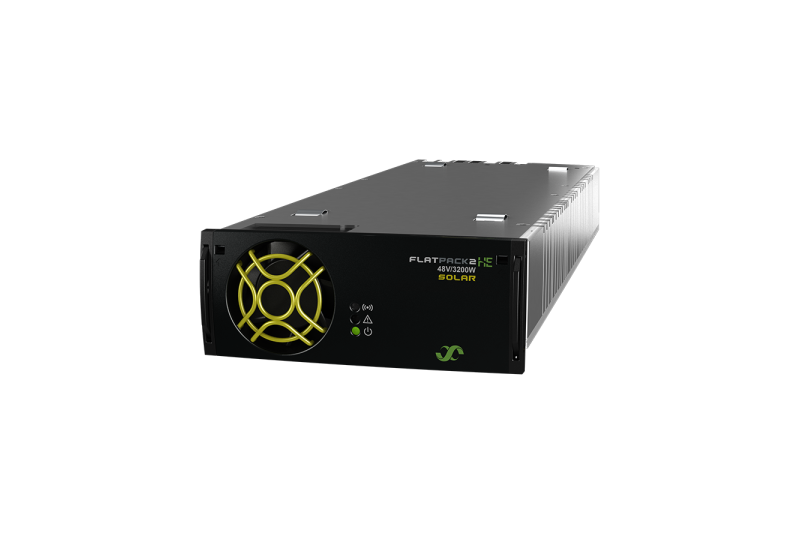
In all three, the heart of the system is the same: a -48 VDC power plant with rectifier modules, a solar charge controller (or MPPT strings feeding the same bus), a battery bank, and a controller that arbitrates sources. The rectifier side uses the same modules as any telecom site — see how to choose a 48V telecom rectifier — typically Huawei R4850G6 modules in a TP48-series cabinet for greenfield builds, or Eltek Flatpack2 where the operator standard is Vertiv/Eltek.
Battery strategy: cycling duty changes everything
The single biggest design mistake in hybrid 5G sites is reusing the backup-power battery playbook for a cycling application. A backup VRLA string in a grid site floats for years and discharges a handful of times. A solar-hybrid battery cycles daily — often 40 to 80 percent depth of discharge — and a battery designed for float duty will die in 12 to 18 months under that regime.
For cycling duty the practical choices are:
Lithium iron phosphate (LiFePO4) 48V rack batteries are our default for 5G hybrid sites. They deliver 3,000 to 6,000 cycles at 80 percent DOD, tolerate partial state of charge (critical in rainy season), accept high charge current for fast solar harvesting, and their BMS gives per-cell telemetry into the site controller. Huawei’s SmartLi 48V rack family is the reference most operators ask for; we also integrate second-tier LFP racks where budget rules. The capex premium over VRLA is recovered within the first VRLA replacement cycle in cycling duty.
OPzV and lead-carbon VRLA remain valid where capex is the binding constraint and cycle counts are moderate (1,500 to 2,500 cycles at 50 percent DOD for OPzV). Lead-carbon tolerates partial SOC better than standard AGM. But weight, floor loading, and the 2 to 3 year replacement cadence in hot climates make total cost unattractive for 5G loads unless the site is civil-works-constrained.
Sizing rule of thumb: for Architecture B, size lithium capacity for 1.5 to 2 nights of busy-hour load (that is autonomy for the dark hours plus a cloudy-day margin), and let solar carry the daytime. For Architecture A, one night of autonomy usually suffices because the grid returns the charging energy cheaply. Never below one night on a 5G site — the traffic peak lands exactly in the hours solar cannot serve.
The controller is the brain: source arbitration and remote operations
A hybrid site lives or dies by its controller. The controller arbitrates solar, rectifier, battery, and (where fitted) generator; enforces battery charge profiles; and reports everything northbound. Modern plants — Huawei’s integrated hybrid controllers, Vertiv NetSure with hybrid additions, or Eltek Smartpack2-based systems — handle the basics out of the box: MPPT channels or external solar controller integration, generator start/stop with battery SOC triggers, and load-shedding outputs for non-critical circuits.
Three controller features matter disproportionately for 5G hybrid towers. First, SOC-based generator governance: start at 30 to 40 percent SOC, stop at 80 to 90 percent, and never chase 100 percent with a generator — the last 10 to 20 percent of charge is the least efficient fuel you will ever buy. Second, load priority outputs: when battery dips, shed the auxiliary loads (air conditioning can drop to fan-only, lights off) before the radio ever notices. Third, NMS integration: if your network operations center cannot see battery SOC trends and solar yield per site, you will find out about a failed string from a subscriber complaint, not an alarm. Insist on SNMP or Modbus northbound from day one.
For sites where the radio line deep-dives on controllers and modules, our 48V rectifier cross-reference chart maps module families across Huawei, Vertiv, Eltek, and ZTE so spares stay interchangeable within a fleet.
Component selection guide for the 5G hybrid bus
Rectifiers: 3 kW class modules are the sweet spot for 5G hybrid sites — enough granularity for N+1 without stranding capacity. The Huawei R4850G6 is the current flagship for TP48 cabinets; its mechanical and protocol compatibility with older R4850G2 slots makes fleet upgrades painless. For a 5 kW busy-hour dual-band site, three R4850G6 modules give you N+1 at busy hour with solar carrying the base load most of the day. Embedded plants like the Huawei ETP48100 suit compact 5G sites and street-level towers where a full cabinet is overkill.
Solar charge side: decide between integrated MPPT channels inside the power plant (cleaner, fewer boxes, Huawei/Vertiv ecosystems) versus external MPPT controllers (vendor-agnostic, sometimes cheaper per watt). Integrated wins for greenfield Huawei-standard fleets; external wins when the site mixes donated or existing arrays. Size array watts at 120 to 150 percent of daily kWh need divided by local peak sun hours — and for Sahel and Gulf sites, derate for 45 °C+ ambient and dust: soiling losses of 15 to 25 percent between cleanings are normal, not exceptional.
Battery: as above, LFP rack for cycling. Rack format (19-inch, 48V/50Ah or 100Ah modules) beats cabinet bolts-on format for incremental expansion — start with two strings, add as traffic grows.
Distribution and safety: DC distribution with per-branch breakers sized for AAU inrush; lightning protection is non-negotiable on towers (Class I SPD on both AC input and DC bus); and for outdoor cabinets in hot regions, thermal management is a real design line item — a 5G site cabinet with 5 kW of heat load needs either a heat exchanger or a precision cooling unit such as the Liebert PEX3 in shelter-scale variants, because battery life halves for every 8 to 10 °C above 25 °C and lithium BMS protection trips are the #1 avoidable outage we see.
Reference BOMs for two common 5G hybrid profiles
Profile 1 — Single-band 5G site, fair grid (Architecture A), southern Europe / North Africa: 1× TP48200B cabinet with 3× R4850G6, 2× 100Ah LFP rack strings (48V), 6 to 8 kWp solar on integrated MPPT, Class I + II SPD, SNMP northbound. Diesel: none retained.
Profile 2 — Dual-band 5G site, poor grid (Architecture B), Sahel / rural East Africa: 1× TP48300B cabinet with 4× R4850G6, 4× 100Ah LFP strings, 14 to 18 kWp solar, external MPPT expansion channels, generator auto-start interface with SOC governance, per-branch load-shedding outputs. Diesel: retained, expected 1 to 3 hours/day average in rainy season.
Both profiles assume -48 VDC throughout, tower-hosted AAUs, and cabinet environmental control sized per climate. We publish these as starting points, not turnkey specs — array sizing is site-specific by definition, and we adjust after reviewing the irradiance data and the operator’s traffic forecast.
Decision tree: which architecture does your tower need?
Ask four questions in order. One: does the grid exceed 20 hours/day availability at acceptable quality? If yes, you are Architecture A — solar-assist only. Two: if grid is poor, is fuel logistics expensive or unreliable? If fuel is the bigger pain, Architecture B with maximum solar. Three: is the site critical (aggregation point, emergency coverage)? Critical sites keep the generator regardless — Architecture C — because autonomy is insurance, not opex. Four: is there structural or civil headroom for 14+ kWp and 4+ battery strings? If not, hybrid-solar is constrained and the design becomes grid-plus-lithium-peak-shaving. This four-question triage resolves 80 percent of the site conversations we have; the remaining 20 percent come down to utility tariffs and capex phasing.
FAQ — Solar-Grid Hybrid Power for 5G Telecom Towers
Frequently asked questions
Q: Can I add solar to an existing 5G site rectifier plant without replacing it?
A: Usually yes. If the plant’s controller supports solar MPPT integration or accepts an external MPPT controller on the same bus, you add an array, the MPPT stage, and battery cycling capacity without touching working rectifiers. The two checks that decide it: controller vintage (does the northbound and generator logic support source arbitration?) and bus distribution headroom (spare breaker slots for the MPPT output). Sites running current-generation Huawei, Vertiv NetSure, or Eltek Smartpack2 controllers integrate cleanly; plants older than roughly 2015 usually justify replacement on cycling support alone.
Q: How much solar does a 5G tower actually need?
A: Working number: daily kWh need divided by peak sun hours, multiplied by 1.2 to 1.5 for losses and soiling. A single-band 5G site at 80 kWh/day in a 5.5 sun-hour region lands at roughly 18 to 22 kWp; in a 4-hour region, 24 to 30 kWp. Dual-band sites scale up from there. The honest answer is that array sizing is cheap relative to truck rolls — undersizing is the expensive mistake, so we size to the rainy-season sun figure, not the annual average.
Q: Lithium or AGM batteries for a hybrid 5G site?
A: For daily-cycling hybrid duty, lithium iron phosphate wins on total cost of ownership in almost every realistic scenario: 3,000 to 6,000 cycles versus 500 to 1,200 for AGM in hot climates, no partial-charge sulfation, and half the weight and floor space. AGM remains defensible only for Architecture A sites with minimal cycling and very tight capex. The crossover is typically 24 to 36 months in cycling duty.
Q: What happens to the batteries during rainy season when solar underproduces?
A: This is the core risk of solar-primary architectures, managed in three layers: oversize the array for the rainy-season irradiance (not annual average), size lithium capacity for 1.5 to 2 nights rather than one, and configure grid or generator opportunistic charging so a multi-day overcast stretch charges the bank at the cheapest available source. Lithium’s tolerance of partial state of charge is what keeps the battery healthy through this pattern; a float-designed AGM bank in the same regime sulfates and loses capacity within months.
Q: Do 5G radios need cleaner DC power than 4G radios?
A: They need tighter voltage behavior under transients, not different cleanliness. Modern AAUs specify operation down to about -43.2 VDC; a surge during generator transfer or a heavily cycling battery at low SOC can dip below that and reset the radio. The battery bank is the transient buffer — which is why we treat battery health and SOC governance as availability features on 5G sites, not just opex features.
Q: Can the hybrid controller really cut generator runtime that much?
A: On solar-primary sites, yes — typical field results after conversion are generator hours dropping from 10 to 14 hours/day to 1 to 3 hours/day, with the remaining runtime concentrated in rainy-season weeks. The governance settings do the heavy lifting: SOC-triggered start/stop, charge-rate windows that run the generator at efficient load, and load-shedding that protects radio availability while the battery recovers.