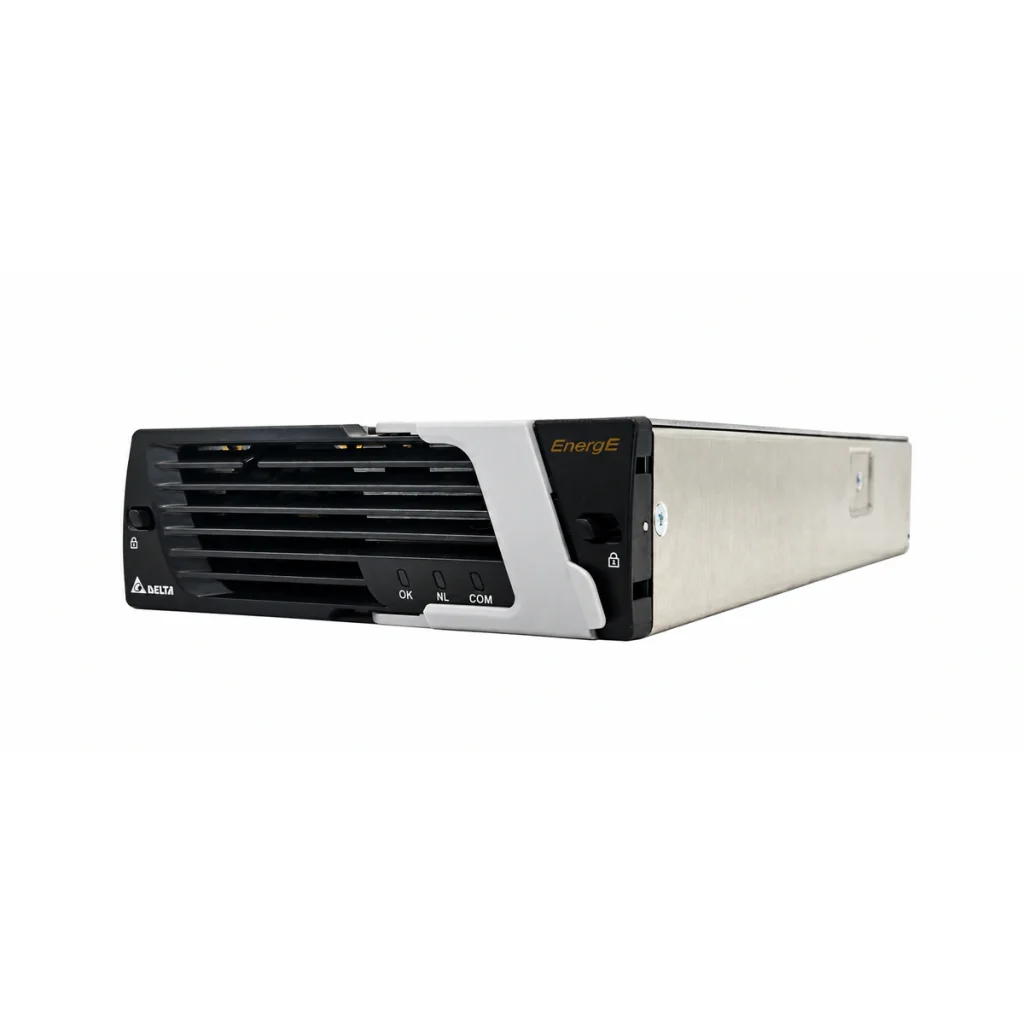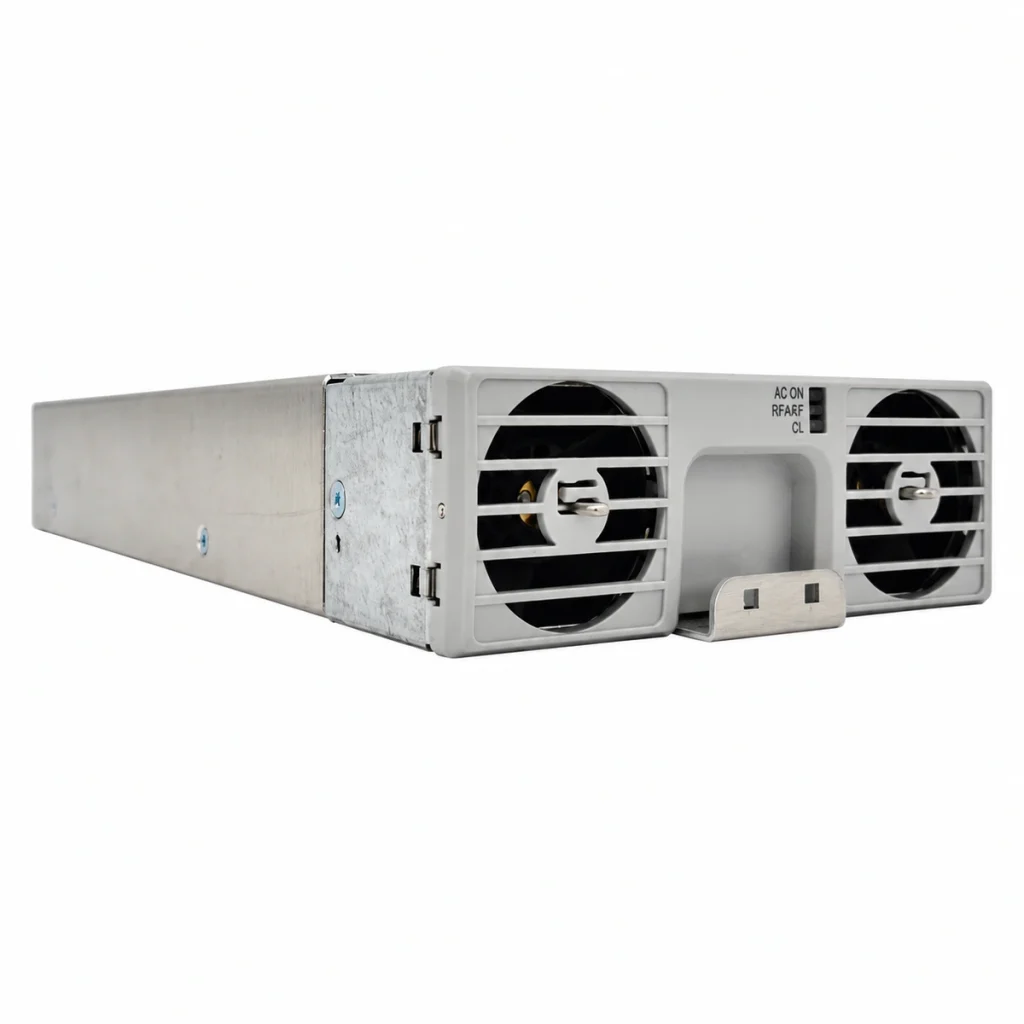
A 5G base station at -48V DC draws between 3 kW and 8 kW depending on radio configuration, antenna count and traffic profile. The Delta DPR48/30G — a 30A, approx 1440W hot-swappable rectifier module — is one of the workhorse options for sites that already run Delta DPR-series power shelves. This guide walks through the complete power-system design for a Delta DPR48/30G deployment at a telecom base station: from load calculation and N+1 redundancy planning, through battery backup sizing, to supervision module integration and field commissioning.
Unlike our product page for the DPR48/30G, which covers the module specifications and ordering details, this guide focuses on the system-level engineering — the decisions that determine how many modules you need, what battery capacity to specify, and how the supervision controller ties everything together.
Step 1: Calculate the -48V bus load
Start from the equipment power sheet, not from generic assumptions. A typical 5G macro site includes:
| Equipment | Typical power draw | Notes |
|---|---|---|
| Active Antenna Unit (AAU) × 3 (massive MIMO) | 3 × 800–1200 W | Varies by vendor and bandwidth config; 64T64R AAUs trend 1000–1400W each |
| Baseband Unit (BBU) | 300–500 W | Includes baseband cards and fronthaul interfaces |
| Transmission (microwave/OTN) | 100–300 W | Depends on link capacity and hop count |
| Auxiliaries (lighting, alarm, camera) | 100–200 W | Site-specific |
| Total DC load | 3.5–5.5 kW | Peak traffic condition; size for this, not average |
Convert the total DC power to bus current: I_load = P_total / V_float. At a 53.5V float voltage, a 4.5 kW site draws approximately 84A. A smaller 4G+5G combined site at 3 kW draws about 56A.
Step 2: Rectifier count with N+1 redundancy
Each DPR48/30G module delivers 30A nominal. Divide the load current by 30A and round up to get the number of working modules, then add one spare:
| Site load | Bus current (at 53.5V) | Working modules (30A each) | N+1 total | Shelf slots needed |
|---|---|---|---|---|
| 2 kW (small cell / CPE) | 37 A | 2 | 3 | 4+ (leave expansion room) |
| 3 kW (4G+5G combined) | 56 A | 2 | 3 | 4+ |
| 4.5 kW (5G macro) | 84 A | 3 | 4 | 6+ |
| 6 kW (dense urban 5G) | 112 A | 4 | 5 | 6+ |
| 8 kW (massive MIMO hub) | 149 A | 5 | 6 | 8+ |
Key rule: N+1 is non-negotiable for any site with a service-level agreement. If one module fails at 3 AM, the remaining modules must carry the full load without interruption. Hot-swap design means the failed module can be pulled and replaced while the system continues operating — but only if the remaining modules have sufficient capacity.
Also consider battery charging current. If the site uses VRLA batteries and needs boost charging, add 10–15% extra capacity beyond the load current. Lithium batteries with BMS-managed charge profiles typically draw less peak current, so the table above is usually sufficient.
Step 3: Battery backup calculation
Backup duration depends on battery capacity (Ah), load power and the allowable depth of discharge:
C (Ah) = (P_load × t_backup) / (V_float × DoD × η_batt)
| Scenario | Load (kW) | Autonomy target | DoD | Battery η | Required Ah (at 48V) |
|---|---|---|---|---|---|
| Urban macro (grid stable) | 4.5 | 2 hours | 80% | 95% | 246 Ah |
| Semi-rural (occasional outages) | 3.0 | 4 hours | 80% | 95% | 329 Ah |
| Off-grid / weak grid | 3.0 | 8 hours | 70% | 90% | 595 Ah |
| Edge DC co-location | 5.0 | 1 hour | 80% | 95% | 138 Ah |
For off-grid and weak-grid sites, pair the DPR48/30G rectifier system with solar PV input through a hybrid-capable Delta shelf. The rectifier modules handle grid power when available; the solar controller supplements during daylight; batteries cover the gaps. This architecture is covered in more detail in our 5G 48V power sizing guide and off-grid solar hybrid guide.
Step 4: Supervision module and monitoring
The DPR48/30G communicates with the Delta supervision controller over CAN bus. The controller performs:
- Rectifier management: Load sharing across all modules, sleep mode for energy saving at light load, fault detection and alarms
- Battery management: Float/boost/equalisation charge profiles, temperature compensation, deep-discharge protection, BMS communication for lithium packs
- Load shedding: Prioritised disconnection of non-critical loads when battery reaches low-voltage threshold
- Uplink: SNMP, Modbus TCP/IP or dry-contact alarm outputs to the operator NOC
For Delta DPR systems, the supervision module is typically a dedicated shelf controller (model varies by shelf generation). Ensure the controller firmware supports the DPR48/30G — newer modules may require a firmware update on older shelves. BS Comtec can confirm controller-model-to-module compatibility when you send us the shelf model number.
Selection configuration guide
| Deployment scenario | Recommended modules | Shelf type | Battery config | Notes |
|---|---|---|---|---|
| Small cell / CPE site (2 kW or less) | 2x DPR48/30G + 1 spare (N+1) | Delta DPR small shelf (4-slot) | 100–200 Ah VRLA or equivalent Li | Compact, single-phase AC input |
| 4G+5G combined macro (3 kW) | 2x DPR48/30G + 1 spare | Delta DPR 6-slot shelf | 200–400 Ah VRLA or Li pack | 3–4h autonomy typical |
| 5G massive MIMO macro (4.5 kW) | 3x DPR48/30G + 1 spare | Delta DPR 6-slot or 8-slot | 250–500 Ah | Size for peak AAU traffic |
| Dense urban hub (6–8 kW) | 4–5x DPR48/30G + 1 spare | Delta DPR 8-slot or dual shelf | 400–800 Ah or Li BMS-managed | Consider dual shelves for future growth |
| Off-grid solar hybrid | Per load calculation + 1 spare | Delta DPR hybrid shelf with solar input | 600+ Ah Li (deep cycle) | Solar controller + rectifier on shared -48V bus |
Field commissioning checklist
- Verify all DPR48/30G modules are seated correctly and locked in the shelf backplane
- Confirm AC input breaker rating matches the shelf documentation
- Power up modules one by one; verify each module LED shows normal operation
- Check supervision controller recognises all modules via CAN bus
- Set float voltage to battery manufacturer specification (typically 53.5V for VRLA)
- Configure battery charge profile (float/boost/equalisation) in the controller
- Verify load sharing: all active modules should show similar current readings
- Test hot-swap: pull one module while under load; confirm remaining modules pick up the load and alarm triggers to NOC
- Verify alarm uplink: SNMP trap or dry-contact signal received at NOC
- Document module serial numbers, shelf configuration, and battery capacity for warranty records
Q: What is the Delta DPR48/30G and where is it used?
The Delta DPR48/30G is a 30A, -48VDC hot-swappable rectifier module for Delta DPR-series telecom power shelves. It converts AC mains to regulated -48V DC and is used in telecom base stations, edge data centres and FTTH OLT sites that run on the Delta ESR-48V platform. Each module delivers approximately 1440W. For sites drawing 3-5 kW at -48V, a typical configuration uses 2-3 working modules plus one redundant (N+1) in a 6-slot DPR shelf. See the DPR48/30G product page for full specifications.
Q: How does the Delta DPR48/30G compare to Huawei R4850G6?
They serve different cabinet ecosystems. The DPR48/30G fits Delta DPR shelves only; the Huawei R4850G6 fits Huawei TP48xxx cabinets only. The two modules are not cross-compatible: different form factors, different backplane pinouts, different controller protocols. The R4850G6 is a 62.5A / 3000W class module (higher per-module capacity), while the DPR48/30G is 30A / approx 1440W. For a site at 4.5 kW, you would need 3x DPR48/30G modules (N+1 = 4 total) but only 1x R4850G6 + 1 redundant. Choose based on which cabinet platform your site standardises on. See the R4850 vs R48 guide for platform decision logic.
Q: How many DPR48/30G modules does a 5G BTS need?
Divide the peak DC load current by 30A (one module), then add one spare for N+1 redundancy. A typical 5G macro site at 4.5 kW draws about 84A at -48V: that requires 3 working modules plus 1 spare = 4 total DPR48/30G modules in a 6-slot or 8-slot Delta DPR shelf. A smaller 4G+5G combined site at 3 kW needs 2 working + 1 spare = 3 modules. Always size for peak traffic, not average load. Refer to the selection table in this guide for detailed configurations across site types.
Q: What is the price of the Delta DPR48/30G?
Pricing depends on quantity, destination and current factory pricing. As a general reference, the DPR48/30G sits in the 30A / 1440W class and is typically priced below the 62.5A / 3000W modules (Huawei R4850G6, Vertiv R48-3000E3) on a per-unit basis, but you need more modules to cover the same total site load. BS Comtec provides same-day quotations with quantity-based pricing from Shenzhen stock. Send your required quantity, destination country and cabinet model to our team for an accurate RFQ via WhatsApp +86 135 8237 6986.
Last updated: October 2026. Load figures are illustrative: always replace with your equipment vendor datasheet values during detailed design. For an RFQ or engineering review, contact BS Comtec via WhatsApp +86 135 8237 6986.